
18.09.2026
Treatment videos for social media: From camera-shy to showcasing expertise
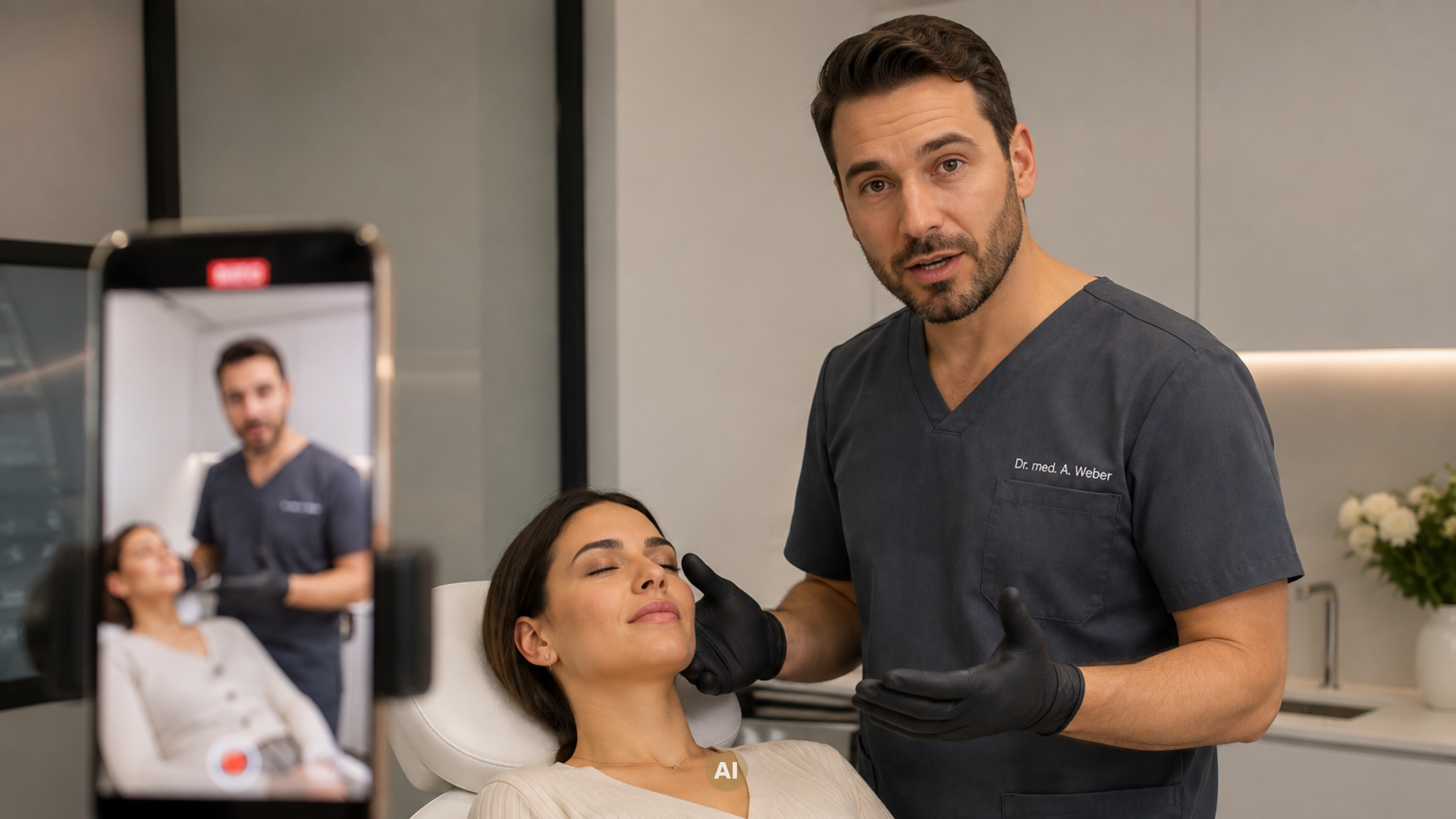
Do you want to build more trust and visibility for your aesthetic practice using social media videos, but aren't sure which content works or what is legally permitted? This article shows you which video formats are suitable, what you should look out for regarding patient consent, and how to produce professional content with manageable effort.
).png)
Javid Safaei
Key takeaways
- Treatment videos are a highly effective way to convey expertise and build trust, provided they remain informative and avoid prohibited before-and-after comparisons.
- Whenever patients appear in a video, you must obtain specific, written, and documented consent for the respective channels and intended use.
- For professional social media content, a modern smartphone, good lighting, and an external microphone are often enough – consistency and relevant content are far more important than expensive equipment.
A patient is very satisfied with her treatment and would, in principle, be a good candidate for a short video. Yet, she is never asked because the team is uncertain about consent, the process, and the right way to approach her. The result: the treatment takes place, but the expertise remains hidden behind the practice door. It is precisely these situations that cause many practices to leave valuable and authentic content unused.
Treatment videos for social media: From hesitation to demonstrating expertise
There is hardly any marketing toolin aesthetic medicine that achieves as much impact while being as consistently avoided as video content. On Instagram and TikTok, doctors are building reach in the hundreds of thousands with authentic treatment videos. In most practices, however, restraint prevails: no video, no reel, no insight. Too complicated. Too risky. Too much effort.
That is a costly mistake.
Video is the format that builds trust the fastest and most convincingly in aesthetic medicine. A doctor who explains, demonstrates, and informs showcases competence in a way that no text or still image can replicate. Those who do not use this channel are leaving it to their competitors.
What is legally permitted – and what is not

The biggest uncertainty regarding treatment videos is the legal side: What is allowed to be shown? What is not? And how does this relate to the restrictions imposed by the Therapeutic Products Advertising Act?
The basic rule is clearer than many think: factual, informative content is permitted. Promotional, suggestive, or comparative content is not.
What this means in concrete terms: A videothat explainshow a treatment is performed, what its indications are, what the recovery process looks like, and what realistic results can be expected, is generally permissible. It informs rather than entices. A video that showcases a dramatic result, before and afterstates in a comparative way, and thereby gives the viewer the impression of a guaranteed result, is inadmissible – regardless of whether it is labeled as "educational."
Regarding the question of before-and-after depictions the ruling by the Federal Court of Justice in its landmark decision of July 31, 2025, is clear: comparative depictions of a person's physical state before and after an aesthetic procedure are, in public advertising, prohibited – even for minimally invasive treatments such as Botox or hyaluronic acid. A detailed legal analysis can be found in our article on before-and-after images in aesthetic medicine.
Permitted and highly effective are, however, the following video formats:
- Indication presentation: Explains which problems a treatment can address – without a direct before-and-after comparison.
- Treatment commentary: The physician explains what they are doing and why during or after the procedure.
- Patient interview: Authentic conversations with consenting patients about expectations, experiences, and their personal treatment journey – without comparative physical depictions.
- Educational video: Provides factual information on treatment options, how they work, duration, and aftercare.
- Practice insight: Showcases the atmosphere, team, treatment philosophy, and values of the practice.
GDPR and patient consent: What needs to be documented
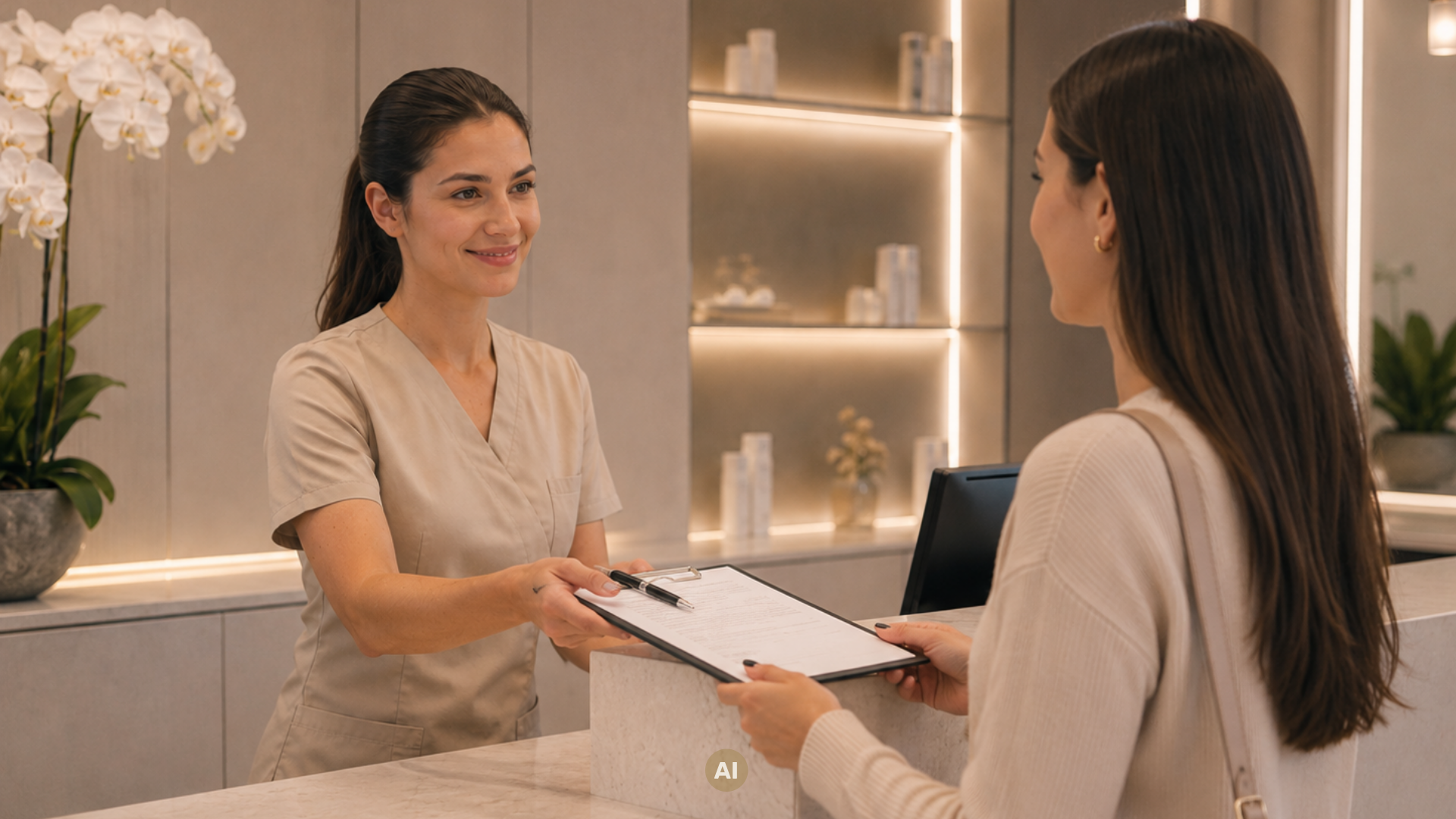
The GDPR (General Data Protection Regulation) governs how personal data must be collected, processed, stored, and protected within the EU.
In addition to the HWG, the GDPR is the second relevant legal framework for treatment videos. Anyone filming a patient and publishing this material on social media requires explicit, written consent—specifically for the intended purpose.
This consent must include the following elements:
- Description of the material: Clearly state which photos or video recordings are being created.
- Channels & formats: Specifically name where the material may be published, e.g., Instagram, TikTok, website, or advertisements.
- Right of withdrawal: Point out that consent can be withdrawn at any time.
- Date & signature: Document the consent in writing and have it signed by the patient.
A general treatment consent form or a blanket disclaimer is not sufficient. Consent must be specific, informed, and documented.
Important for your practice: If a patient withdraws their consent at a later date , the material must be removed from all channels. While this rarely happens in practice, the infrastructure to do so must be in place. It is advisable to manage all published videos and their corresponding consent forms in a simple overview so you can react quickly in the event of a withdrawal.
The mindset problem: Why doctors don't ask – and why they should
The most common reason, why aesthetic practices do not produce video content is not due to the technology or the legal situation. It is the hesitation to even ask patients.
This hesitation is understandable – but it costs you potential every day. The reality is: many patients are proud of their results. They are happy to share them if they are asked the right way. And those who say no simply say no – with no consequences for their relationship with the practice.
The decisive principle here is statistically simple: the more people you ask, the more will say yes. If you ask ten patients a month, you will likely find two or three who are willing to participate. If you ask no one, you get no content.
The mindsetrequired is that of a documentarian, not a salesperson's. A doctor documents their work to help others make the right decision – and to show what they do in an honest way. This perspective makes asking easier and communication with the patient more authentic.
The specific phrasing during the conversation could sound like this:
"We like to document our work for social media to help others make the right decision. Would you be willing to support us in this – completely voluntarily and revocable at any time?"
This phrasing removes the sales aspect from the request and positions the patient as an active supporter – not as an advertising prop.
Should you offer discounts for content?
A frequently asked question: Should you offer patients a discountif they are available for video content?
The answer is nuanced. In principle, it should Goal is to generate content without compensation — because authentic endorsement without financial incentive is more persuasive, and because a practice that offers discounts for every piece of content systematically undermines your margins.
If discounts are offered, they must be exclusively in exchange for a clear and documented quid pro quo: written consent for the unlimited use of the material on social media and in advertisements. This agreement must be contractually binding—a simple consent form that explicitly mentions the use for advertising purposes and the benefit provided is sufficient.
What is not recommended :
- No verbal agreements: Consents should always be documented in writing and be easily traceable.
- Clearly define the scope of use: It must be explicitly specified which channels and purposes the material may be used for.
- No one-off verbal consent: A brief verbal agreement during a conversation is not a sufficient basis for reliable consent.
Which formats work – and on which platforms
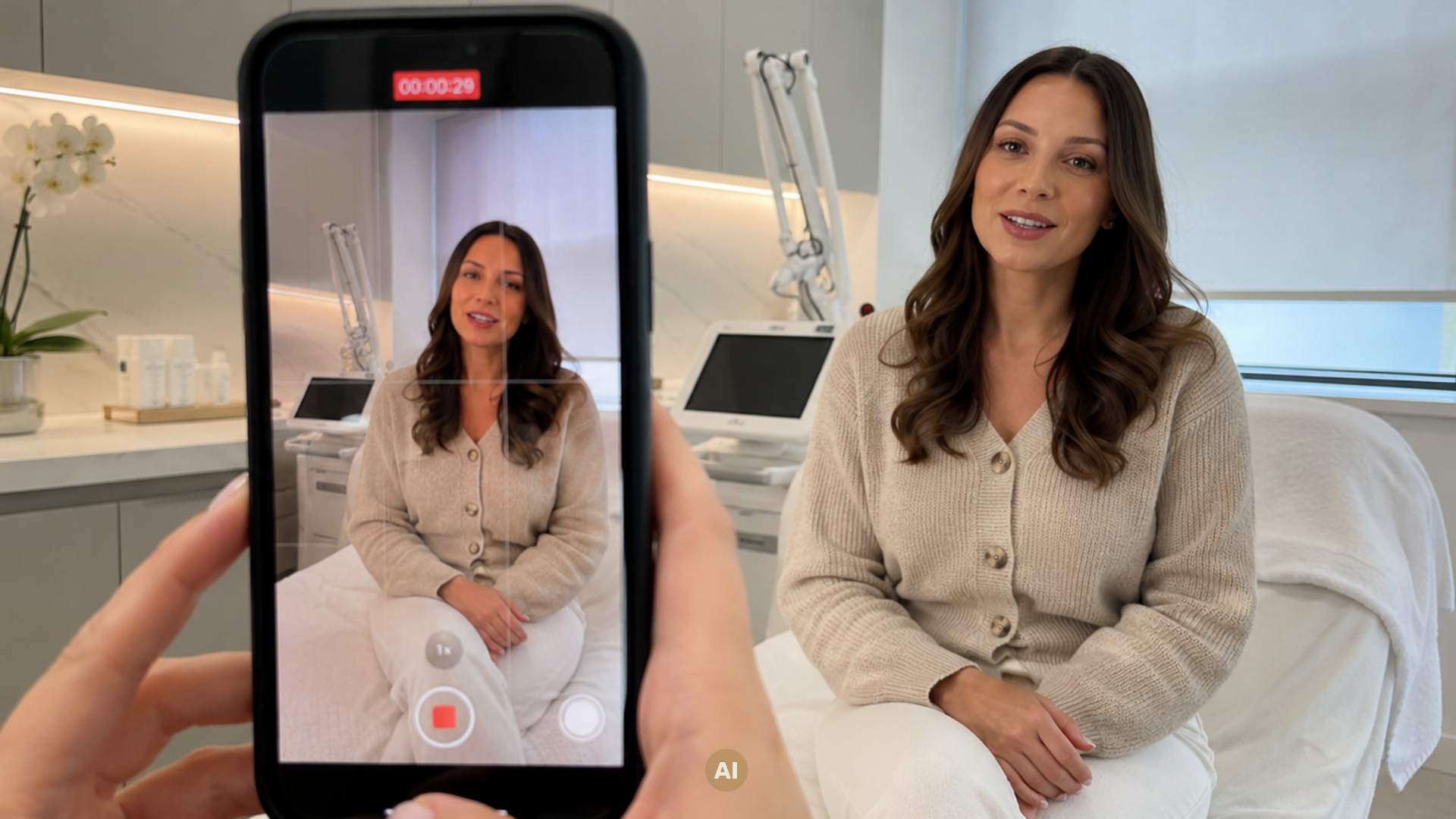
Not every video format has the same impact. For aesthetic practices, the following formats have proven to be particularly effective:
Reels and TikToks – short, informative, repeatable
Videos between 30 and 90 secondsthat answer a specific question or show a treatment procedureperform best on Instagram and TikTok. The hook must grab attention within the first two seconds, or users will scroll past. A strong opening sentence, a surprising question, or a visually engaging moment are crucial.
Educational videos – building trust through knowledge
Longer videosthat explain a treatment, how it works, or common misconceptionsbuild authority and expertise These formats perform particularly well on YouTube and as saved content on Instagram—they may not go viral as often, but they are viewed more frequently by people who are genuinely looking for information.
Patient conversations and testimonials
Authentic conversations with satisfied patients —without comparative body imagery—are the most powerful form of social proof available in aesthetic medicine. A video in which a patient explains why they chose this practice, what their experience was like, and how they feel now is more persuasive to potential patients than any paid content could ever be.
Practice insights and team content
Videos that showcase the atmosphere of the practice, the doctor's philosophy, and the team build emotional connection. They answer the unspoken question many prospective patients have: Will I feel comfortable there? Do I trust this person?
For all formats, the following applies:
- Vertical format (9:16): Ideal for Instagram Stories, Reels, and TikTok; it should be filmed in this orientation whenever possible.
- Landscape format: Particularly suitable for YouTube and for embedding on your website.
Tip: If you keep both formats in mind while filming, you can efficiently use the same material across multiple channels.
Equipment: What you really need – and what you don't
The most common excuse for a lack of video content in practices is equipment. Yet the requirements are much lower than most people assume.
Three factors are absolutely critical for professional-looking video:
- Lighting. Poor lighting makes even expensive cameras useless. A simple ring light or a small softbox set for 100 to 200 euros will dramatically improve the perceived quality of a video. The setting should always be consistent—the same lighting, the same background—so that your practice's content has a recognizable look.
- Audio. Poor audio is the number one reason viewers stop watching videos early. A simple lavalier microphone for 30 to 80 euros delivers significantly better results in almost every situation than a built-in smartphone microphone. For voiceover formats, a basic USB microphone is sufficient.
- Camera. A modern smartphone with a good camera—iPhone 12 or newer, current Samsung Galaxy S series—provides more than enough image quality for social media content. A dedicated camera is nice to have, but not a must.
The editing can and should be handled by an external party – a video editor or a social media agencythat turns raw footage into finished formats. The doctor doesn't need to edit. They only need to film.
The ideal setup for an aesthetic practice: a permanent filming station in a quiet room at the practice, with consistent lighting, a clean background, and a microphone ready to go. This setup is always ready, making it easy to spontaneously record a short video whenever the opportunity arises.
What really converts: The most high-impact videos
Based on our experience working with over 270 aesthetic practices and clinics in the DACH region, these video formats are among the most effective for patient acquisition:
- Treatment commentary: The doctor explains what they are doing and why during the procedure – this creates transparency and builds trust.
- Q&A video: Common patient questions are answered directly, helping to reduce typical anxieties before a treatment.
- Patient interview: Authentic post-treatment conversations serve as powerful social proof – without the need for comparative body imagery.
- Practice tour: Showcases the atmosphere, team, and quality standards, giving prospective patients a feel for the practice before their first appointment.
What these formats have in common is that they inform, they showcase, they build trust. They are the exact opposite of advertising – and that is precisely why they work.
Conclusion
Video content is the most powerful tool available for building trust and demonstrating expertise in aesthetic medicine. The legal requirements are clear and manageable: factual, informative content is permitted, while suggestive "before-and-after" comparisons are not. The technical requirements are minimal: lighting, sound, and a smartphone—that is all you need for professional-looking content. And the biggest hurdle—the hesitation to ask patients—is a matter of mindset, not feasibility.
Practices that consistently produce video content build a digital foundation of trust that paid advertising alone can never generate. They attract patients who arrive already convinced because they feel they know the doctor before they even step into the practice.
Curia Consulting supports aesthetic practices in developing legally compliant content strategies—from consent documentation and production planning to the cross-channel distribution of video content.
Make your expertise visible on social media
We will work with you to develop a legally compliant content strategy and establish clear processes for video formats, patient consent, and regular production in your practice.
FAQ
Frequently asked questions about treatment videos for social media
Hier finden Sie Antworten auf die wichtigsten Fragen
Am I allowed to film patients during a procedure?
Yes—with written consent and provided that the material is factually informative and does not construct a comparative representation of the body's condition before and after the procedure. The procedure itself can be shown if it is accompanied by informative commentary and does not create an impermissible promotional effect.
Do I need new consent for every video?
A well-drafted consent form can cover multiple usage scenarios, provided it is sufficiently specific. It is advisable to document comprehensive consent whenever working with a patient that covers all planned forms of use, rather than asking for each video individually after the fact.
Can I also use patient videos in paid advertisements?
Yes—if the consent explicitly includes use in advertisements. This form of usage must be clearly stated in the consent form. Additionally, Meta's platform policies apply: videos containing suggestive body comparisons will be rejected, even with consent.
How often should a practice produce video content?
Quality beats quantity—but consistency is more important than both. Two to three well-produced videos per week are significantly more effective than daily, unstructured output. The realistic approach for a busy practice: a permanent filming setup, one production day per month, and an external editor to process the footage.