
04.09.2026
Sales training for the front desk: Small changes, big impact in aesthetic practices

Are you generating new inquiries regularly, but too few of them are actually turning into booked consultations? Often, the bottleneck is not in marketing, but in the first contact with your practice. This article shows you how sales training, conversation scripts, and clear processes can improve the booking rate at your reception.

Javid Safaei
Executive summary
- The front desk plays a decisive role in turning an inquiry into a booked consultation – making it a direct driver of revenue.
- Conversation guides, targeted questioning techniques, objection handling, and concrete appointment suggestions ensure more professional and consistent communication.
- Through follow-ups, recall processes, and regular quality control, you can reduce lost inquiries and proactively reactivate existing patients.
Ten prospective patients contact your practice after a successful campaign, but only four actually book an appointment. For the other six, it often remains unclear why they dropped off. Perhaps an objection wasn't addressed, no specific appointment was offered, or the inquiry wasn't followed up on. It is precisely these everyday situations that show how heavily front desk communication influences the success of your marketing.
Why untrained front desk staff are set up to fail
The receptionist or medical assistantwho answers the phone has rarely, if ever, been trainedfor this task. Their training focuses on practice organization, medical assistance, and appointment management—not on conversation techniques, handling objections, or the psychology of sales.
This is not a criticism of the individual—it is a structural problem. Without proper training, they cannot know how to effectively engage a prospective patient on the phone, how to respond to common objections, or how to guide an undecided caller toward booking an appointment.
Furthermore, the quality of phone interactions depends heavily on the individual's mood when there is no script or training in place. An employee who has had a difficult morning will conduct a different conversation than on a good day. A prospective patient calling at that exact moment receives a different experience—and the practice owner has no insight into what is actually happening in these calls.
The result is a complete reliance on chance: Who calls, when they call, and the mood of the person on the other end of the line determine the quality of patient communication. That is not a strategy—that is luck.
What sales training for the front desk actually means
Sales training for the front desk does not mean turning medical staff into aggressive salespeople. It means giving them the communication tools they need to professionally welcome prospective patients, build trust and schedule the next step.
The four core areas of this training
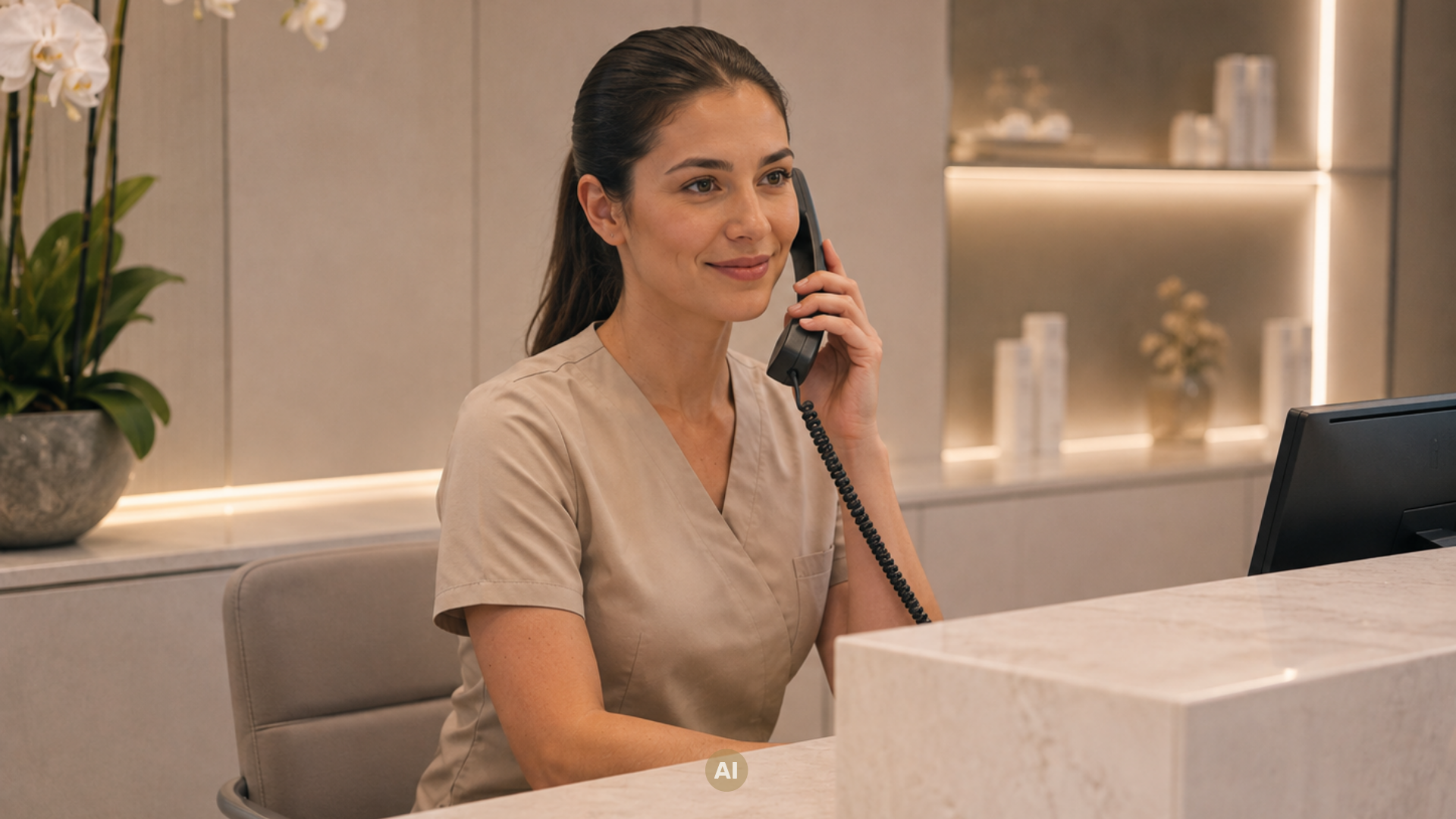
1. Opening the conversation and first impression
The The first sentence on the phone sets the tone for the entire conversation. A professional, warm, and competent opening – practice name, your name, a genuine greeting – immediately signals to the caller: I’ve come to the right place. They have time for me here. The alternative, a rushed, impersonal opening, sends the exact opposite signal.
2. Asking the right questions effectively
The most important tool in an initial consultation is not explaining, but asking questions. If you understand what is specifically driving a prospective patient—what problem, desire, or uncertainty they have—you can tailor the conversation accordingly. Questions like "What brought you to us?" or "What is particularly important to you regarding your treatment?" open up a conversation on equal footing while providing the information needed to give a compelling response.
3. Handling objections
The most common objections during an initial consultation at an aesthetic practice are predictable: "I need to think about it," "Can you give me the prices first?", "Maybe I'll do it next year," or "I've looked at other practices, too." Every one of these objections has an effective response, but that response must be practiced. If you reply to "I'll think about it" with "No problem, feel free to call us back," you lose the lead. If you ask instead, "What else would need to be clarified for you to feel confident in your decision?", you keep the conversation going.
4. Scheduling and Closing
The goal of every initial consultation is a concrete next step, which is usually a consultation appointment . This must be actively offered with a specific time proposal: "I have Tuesday at 3 p.m. or Thursday at 10 a.m. available – which works better for you?" This alternative-choice technique—offering two specific options instead of the open-ended question "When would you have time?"—measurably increases booking rates. It is easier for someone to choose between two options than to come up with a time from scratch.
Scripts and Guidelines: Structure Beats Improvisation
The most effective tool for consistent quality in patient communication is a structured conversation guide – not a rigid script to be read word for word, but a framework that systematically outlines the key stages of a conversation, standard questions, and responses to objections.
A good guide covers the following situations: incoming new inquiries via phone, incoming inquiries via forms or social media, appointment confirmations and reminders, conversations with prospective patients who did not show up, recall calls with former patients, and post-treatment feedback conversations.
For each of these situations, there is an optimal conversation structure – and this structure must be trained, practiced, and internalizedbefore it can work in a real conversation. This means: role-playing, feedback loops, and regular repetition. One-off training sessions without follow-up are ineffective. Lasting, effective training is a continuous process, not a one-time event.
The underestimated reach: Everything the front desk covers
A common misconception: The role of reception is limited to incoming calls. That is not true – and anyone who thinks so is leaving the vast majority of this role's potential untapped.
The full scope of a professionally staffed and trained reception or telesales role includes:
- Incoming calls: Professionally handling new prospects from advertising campaigns, Google, or referrals and guiding them purposefully to the next step.
- Form inquiries: Actively following up on leads who have filled out a form but have not yet booked an appointment.
- Appointment confirmations & reminders: Systematic reminders help to reduce no-shows.
- Recalling former patients: Proactively contacting inactive patients and reactivating them for follow-up appointments or further treatments.
- Post-treatment feedback: Short follow-up calls strengthen patient loyalty, identify dissatisfaction early, and create opportunities for future bookings.
- Follow-up after consultations: Contacting prospects who did not book immediately after two to three days to answer any outstanding questions.
- No-shows & cancellations: Proactively following up on missed or cancelled appointments and offering a new time slot.
All these touchpoints are revenue drivers. And they all require the same foundation: Training, scripts, processes, and quality control.
The telesales option: When the front desk isn't enough

In many aesthetic practices, the receptionist or medical assistant is already fully occupied with administrative tasks. Patient intake, appointment scheduling, billing, coordination—all of this takes time. Expecting the same person to simultaneously conduct professional sales calls, follow up on incoming campaign inquiries, and make proactive recall calls is unrealistic.
The structural solution is a dedicated telesales person – an employee whose primary task is professional patient communication across all channels. This person is not responsible for administration, not for billing, not for the front desk. They have one job:
turning prospects into patients and patients into loyal, long-term clients.
The investment in a qualified telesales person pays off itself in well-managed aesthetic practices, usually within a few months, because the additional revenue generated by this role significantly exceeds the personnel costs. A telesales person who books three additional consultation appointments daily, two of which result in treatments, generates 1,200 euros in additional daily revenue with an average initial transaction of 600 euros, simply by systematically following up on inquiries that would otherwise have been lost.
Quality control: What isn't measured doesn't improve
Perhaps the most important element of the entire system is quality control. A doctor who doesn't know what their reception staff's calls sound like cannot judge whether they are going well or poorly. They rely on gut feeling—and gut feeling is a poor basis for business decisions.
Concrete quality control measures include: regular call recordings with the appropriate employee consent, structured feedback based on a standardized evaluation form, monthly analysis of the conversion rate from inquiry to consultation appointment, and quarterly refresher training.
Only once this data is available can the practice owner assess: How many inquiries turn into appointments? Where do conversations drop off? Which objections are not being handled correctly? And how is each team member performing?
Without this data, the quality of patient communication remains a blind spot—with direct, unseen consequences for revenue.
Conclusion
The reception is the most underestimated revenue lever in aesthetic medicine. Every day, inquiries are lost, upselling opportunities are missed, and former patients are not reactivated—simply because the person on the phone lacks the tools they need for the job.
Sales training, scripts, guidelines, and systematic quality control are not optional extras—they are the foundation for patient communicationthat actually works. Practices that pull this lever see results quickly: more booked appointments, fewer lost inquiries, higher patient retention, and a measurable increase in monthly revenue—without spending a single extra euro on advertising.
Curia Consulting develops tailored telesales concepts for aesthetic practices and clinics in the DACH region: from recruiting the right telesales staff and developing practice-specific call scripts to ongoing quality control and training.
Make more of your patient inquiries
We support your team with practice-specific conversation scripts, sales training, and clear processes to professionally guide prospective patients and convert more inquiries into booked appointments.
FAQ
Frequently asked questions about sales training for the reception
Hier finden Sie Antworten auf die wichtigsten Fragen
Isn't sales training inappropriate for medical staff?
No – and this misunderstanding stems from a false association of "selling" with aggressive tactics. Professional patient communication means listening with empathy, building trust, conveying information clearly, and actively facilitating the next step. This is not a contradiction to medical professionalism; it is a complement to it. Patients who are well cared for feel more secure and find it easier to make decisions. Everyone wins.
How long does it take for sales training to show measurable results?
With consistent implementation—using scripts, training, and quality control—initial measurable improvements in booking rates are typically visible within four to eight weeks. The full impact unfolds over three to six months, once the training has become routine.
Should I train my reception staff or hire a telesales person?
In smaller practices with a manageable volume of inquiries, training existing reception staff is often the first and right step. In practices with high campaign volumes, active recall management, and multiple parallel communication channels, a dedicated telesales person is the structurally superior solution. The two are not mutually exclusive—in growing practices, both are often beneficial.
What are the most common objections on the phone—and how do you handle them?
The three most common objections are "I'll think about it," "How much does it cost roughly?" and "I'm looking at other practices too." For the first objection: ask actively what is still unclear and offer a no-obligation consultation as the next step. For the second: place price questions in the context of the individual treatment plan and invite them to a consultation for concrete figures. For the third: communicate the uniqueness of the practice briefly and convincingly, then make a concrete appointment proposal—those who have an appointment compare less.