
11.09.2026
Attracting your ideal patients: The 5-point strategy for premium patient acquisition in aesthetic medicine

Do you want to attract more patients who consciously choose quality instead of comparing your practice primarily on price? This article shows you five key levers to specifically align your positioning, communication, and patient acquisition with your ideal patients.

Georg Hutzschenreuter
Key takeaways
- Premium patient acquisition begins with clear positioning that focuses on quality, specialization, and trust—not price promotions or discounts.
- Content, testimonials, and referrals provide the necessary proof of quality and ensure that potential patients arrive for their consultation with a high level of pre-existing trust.
- A well-thought-out approach to pricing and early qualification help reduce price negotiations and shift the focus of consultations toward goals, quality, and results.
A prospective patient compares several practices for the same treatment. One advertises special prices and promotions, while another consistently conveys expertise and quality through its website, content, reviews, and consultations. Even though the second practice is more expensive, the patient chooses them—because price is no longer the primary criterion for comparison. This perfectly illustrates how strongly positioning influences the type of patients a practice attracts.
The root problem: Price discussions as a symptom, not the cause
When practice owners say "My patients always ask about the price first", it is rarely a problem with the price itself. It is a problem of framing—in other words, the basis upon which the decision is being made.
Anyone who gets into a price discussion has already lost. Because in a price discussion, there is always a provider who is cheaper. Always. The only discussion a premium practice can win is the quality discussion. And that discussion doesn't start during the consultation—it starts with the first contact with the brand, the first Instagram post, the first look at the website, the first sentence in an ad.
Premium patient acquisition is therefore not a sales issue. It is a systemic issue that encompasses marketing, brand communication, content, pricing, and sales equally. The following five points cover this system in its entirety.
1. Premium positioning – the brand as the first filter
The positioning of a practice determines which people it attracts – even before a single word is spoken. Anyone visiting a practice website, opening an Instagram account, or seeing an ad makes an unconscious assessmentwithin seconds: Is this the right practice for me or not?
This assessment is based on visual and content-related signals, which in their entirety form the brand image . Colors, typography, imagery, tone of voice, and word choice—all of this communicates a positioning, whether intentional or not. A practice whose visual appearance seems cheap or generic, whose content primarily highlights prices and promotions, and whose communication fails to radiate clear expertise will attract price-sensitive patients. Not because the practice is bad, but because its signals are attracting the wrong audience.
Premium positioning specifically means:
- High-quality appearance: Colors, fonts, and imagery should be consistent and convey quality and professionalism.
- No price promotions: Discounts, special offers, and price-focused messaging should not dominate your communication—the focus should be on quality, results, expertise, and trust.
- Clear specialization: A clear positioning makes the practice perceived as a specialist and sets it apart from the competition.
- Consistent communication: Website, Instagram, Google profile, practice premises, and telephone contact should all convey the same high-quality positioning.
The brand is the first and most important filter. It determines who even begins to engage with the practice. Anyone sending the wrong signals here will be fighting an uphill battle in all subsequent steps.
2. Content marketing as proof of quality
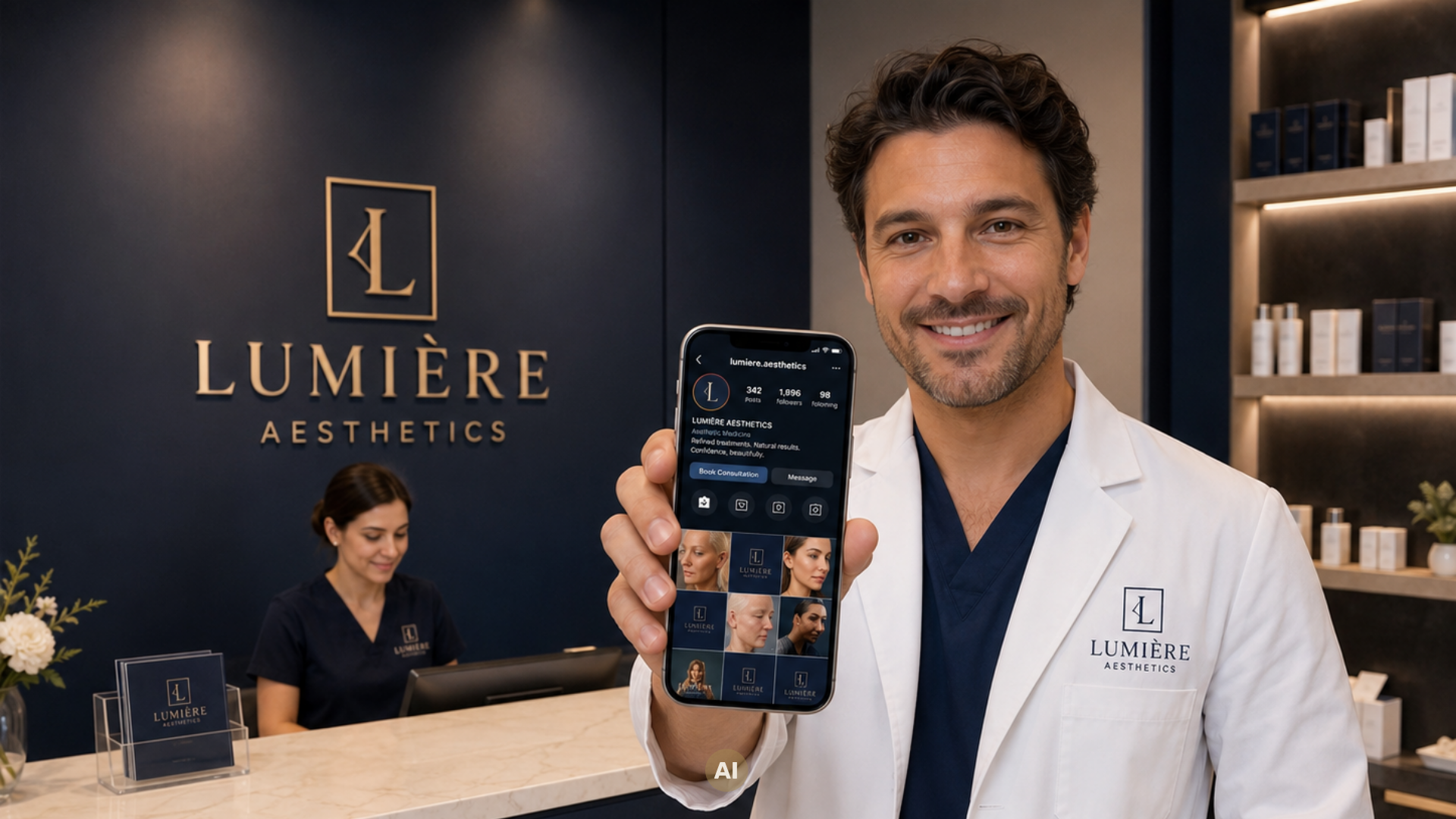
If the brand is the filter, then content is the proof. Premium patients—people who are willing to pay for quality—do not make impulsive decisions. They research, observe, and compare. And they choose the practice that has most convincingly demonstrated quality and expertise during this research and observation phase.
Content marketing in aesthetic medicine, therefore, has a specific strategic function: It provides proof of quality before the patient even makes initial contact. Someone who follows a practice's Instagram account for six weeks, has watched their reels on treatment philosophy and results, and has read their posts on quality and expertise, enters the consultation with a completely different mindset than someone who found the practice through a generic ad.
High-quality content for premium patient acquisition focuses on:
- Explaining treatment results: Instead of before-and-after comparisons, the treatment approach, technique, and the underlying medical philosophy should be communicated in an understandable way.
- Demonstrating professional expertise: Educational content makes it clear that the physician understands the underlying connections, makes well-founded decisions, and explains things clearly.
- Personality & authenticity: The physician's attitude, treatment philosophy, and personality create a sense of connection and differentiate the practice from the competition.
- Showcasing qualifications: Awards, certifications, advanced training, and conference participation serve as evidence of quality and professional standards.
What premium content does not include: Price promotions, discounts, countdown timers"Save now" messages. Each of these forms of communication sends a clear signal – and it is the wrong one.
3. Testimonial strategy – social proof of quality
Social proof is one of the strongest conversion factorsin aesthetic medicine. However, not all social proof attracts the right patients. A practice whose reviews primarily praise low prices attracts bargain hunters. A practice whose testimonials focus on quality, results, and experience attracts quality-conscious patients.
Premium testimonials do not happen by chance – they are built systematically. Specifically, this means:
- Consent and testimonial management: Proactively asking satisfied patients for specific feedback on their experience and results – rather than just a star rating.
- Targeted guiding questions: Questions like "What convinced you about the quality of the treatment?" steer reviews more toward quality, experience, and trust rather than price.
- Video testimonials: Authentic patient videos without comparative body imagery are particularly persuasive and are among the most powerful social proof formats.
- Ideal placement: Treatment-specific testimonials should be placed directly on the relevant landing pages or treatment pages to ensure maximum relevance for prospective patients.
4. Referral marketing – ideal patients refer ideal patients
One of the most underestimated acquisition channels in aesthetic medicine is systematic referral marketing. Referrals have a quality that no paid marketing channel can replicate: they come with pre-established trust. Patients who come through a referral have fewer doubts, compare less, and convert faster.
Even more important for premium patient acquisition: people refer within their social circles. If you already have premium patients—people with a specific lifestyle, purchasing power, and quality standards—you can systematically attract more people from the same circles through structured referral marketing.
Effective referral marketing in aesthetic medicine includes:
- The right timing: It is best to request referrals after a particularly positive treatment result or during follow-up care, when patient satisfaction is at its peak.
- No discount incentives: Financial incentives can undermine your premium positioning and may be problematic from a professional legal standpoint.
- Appreciation & exclusivity: Referrals should be encouraged through recognition, trust, and the feeling of a special patient relationship.
- Simple referral process: Patients should know exactly how to recommend the practice and what the person they refer can expect.
- B2B referral relationships: Collaborations with dermatologists, dentists, personal trainers, wellness facilities, and other relevant partners can generate high-quality referrals from the same target audience.
5. Price communication and budget qualification – preventing the price discussion

The final and often underestimated lever lies in the way prices are discussed – and how to prevent the wrong conversation from taking place.
Premium practices do not list fixed prices in their public communications. Not because they want to be opaque, but because a fixed price reduces the decision to a matter of cost—opening up exactly the kind of discussion they aim to avoid. Instead, they communicate that treatment is planned individually based on scope, goals, and needs. The price is determined by the individual treatment plan.
This phrasing shifts the focus from price to results. It simultaneously signals that this is not a standardized, off-the-shelf service, but a bespoke solution—which increases willingness to pay.
During the initial acquisition process —that is, on the landing page, in forms, and during the preliminary phone call— budget is actively qualified. This means that forms optionally ask for the desired treatment area and an approximate budget. The preliminary phone call clarifies early on whether a realistic budget is in place. During the consultation, the financial framework is established at the beginning—not at the end, after time and trust have already been invested.
This budget qualification has two functions:
- Make efficient use of consultation time: Budget qualification helps avoid conversations with prospects who do not have a realistic budget for booking.
- Focus on quality and results: At the same time, the conversation is steered from the very beginning toward treatment goals, quality, and individual benefits—rather than price.
In the consultation itself, the same principle applies: The doctor or consultant discusses goals, options, results, and the individual treatment plan. The price is communicated at the end as a logical consequence of the defined scope of treatment—not as the starting point of the discussion. Anyone who frames the conversation around results and quality makes the price a secondary issue.
The system in practice: All five points work together
These five points only reach their full potential when working in tandem. Strong positioning without high-quality content loses patients during the research phase. Excellent content without strategic testimonials is not fully convincing. A referral system without clear positioning brings in the wrong leads. And even the best groundwork fails if price communication during the consultation reduces the discussion of quality to a matter of cost.
Premium patient acquisition is a system – not a single lever. Practices that consistently implement all five points typically experience a significant shift in their patient structure: fewer price negotiations, higher conversion rates during consultations, higher average treatment revenue, and stronger patient loyalty – because quality patients are more loyal than bargain hunters.
Conclusion
Anyone who consistently attracts price-sensitive patients does not have a pricing problem, but a positioning problem. The solution is not to become cheaper – but to consistently align every signal a practice sends out with quality. Positioning, content, testimonials, referral systems, and price communication form a system that collectively determines which people a practice attracts – and what kind of discussion takes place during the consultation.
Practices that consistently build this system do not just gain better patients. They gain them more easily, with higher average revenue and with less effort – because quality patients negotiate less often, are more loyal, and provide more frequent referrals.
Curia Consulting supports aesthetic practices in the DACH region with strategic repositioning – from brand development and content strategy to optimizing the consultation process for premium patient acquisition.
Attract more ideal patients to your practice
We help you consistently align your positioning, communication, and patient acquisition with quality—so you spend less time discussing prices and more time reaching the right patients.
FAQ
Frequently Asked Questions About Premium Patient Acquisition
Hier finden Sie Antworten auf die wichtigsten Fragen
Can a smaller practice actually attract premium patients?
Yes—and often more easily than larger clinics. Premium positioning isn't about the size of your practice; it’s about clarity. A solo practice with a doctor who has a clear specialization, a strong personal brand, and consistent quality communication can attract premium patients just as effectively as a clinic with ten practitioners. Often even more effectively, because the doctor’s own personality becomes the strongest differentiator.
Do I have to raise my prices to attract premium patients?
Not necessarily—but your price communication must change. A practice can have market-standard prices and still attract premium patients if all other signals—brand, content, presence, and quality of consultation—communicate excellence. Conversely, a practice with high prices and weak positioning will continue to attract the wrong patients. Price is one signal among many, not the deciding factor.
How quickly does repositioning take effect?
Repositioning is not a one-time project, but a process. With consistent implementation, the first measurable effects—such as a change in the quality of inquiries and fewer price-related discussions—are often noticeable after three to six months. The full impact on your patient structure typically becomes apparent after six to twelve months, once the new positioning is consistently anchored across all channels.
How do I qualify budget during the initial phone call without sounding dismissive?
The phrasing is key. Don't ask, "What is your budget?"—that sounds transactional and is off-putting. Instead, try: "To ensure I can create a realistic treatment plan that is right for you during our consultation, do you have a rough idea of the investment range you are comfortable with?" This frames the budget question as a service rather than a qualification test.