
05.06.2026
Practice marketing for aesthetic medicine: What really works (and what doesn't)
Are you looking to attract more self-pay patients to your aesthetic practice, but finding that individual advertising efforts aren't delivering the results you want? Unlike general medical practices, potential patients compare services, prices, reviews, and providers very carefully before making a decision. This article shows you which six marketing levers are particularly relevant for aesthetic practices, how to improve your visibility and patient loyalty, and which common mistakes are holding back your growth.

Javid Safaei
Executive summary
- Aesthetic practices primarily target self-pay patients who actively compare providers. That is why their marketing requires a different strategy than that of a general practitioner's office.
- Sustainable patient acquisition is not achieved through paid advertising alone, but through the interplay of local visibility, a compelling website, social media, reviews, and targeted patient retention.
- Which measures make sense depends on the specialty, location, range of treatments, and the desired patient demographic. Blanket marketing solutions are therefore often insufficient.
A prospective patient searches Google for an aesthetic treatment in her city. She opens several practice websites, compares reviews, visits the respective Instagram profiles, and checks whether prices, treatment focuses, and appointment options meet her expectations. One practice appears high-quality but displays outdated images online and fails to answer key questions. Another practice presents itself consistently across all channels and builds trust even before the first point of contact. Although both offer medically comparable services, the decision usually falls in favor of the practice that leaves the more professional overall impression.
Why practice marketing for aesthetic medicine is a discipline of its own
Anyone running an aesthetic medicine practice – whether in dermatology, plastic surgery, aesthetic dentistry, or anti-aging medicine – faces a different starting position than the general practitioner around the corner.
The crucial difference: Your patients are customers. They choose consciously and compare actively and pay out of pocket. According to Destatis, 24.5% of revenue for established medical practices already comes from private patients – in aesthetic practices, this figure is often between 60% and 90%. This changes everything: the communication, the channels, and the expectations.
At the same time, the market has become significantly more competitive in recent years. In major German cities, 20 or more practices often compete for the same target patients. Anyone using generic marketing here is wasting their budget.
The 6 most important levers in practice marketing for aesthetic medicine
1. Online visibility: Being found before the competition even appears
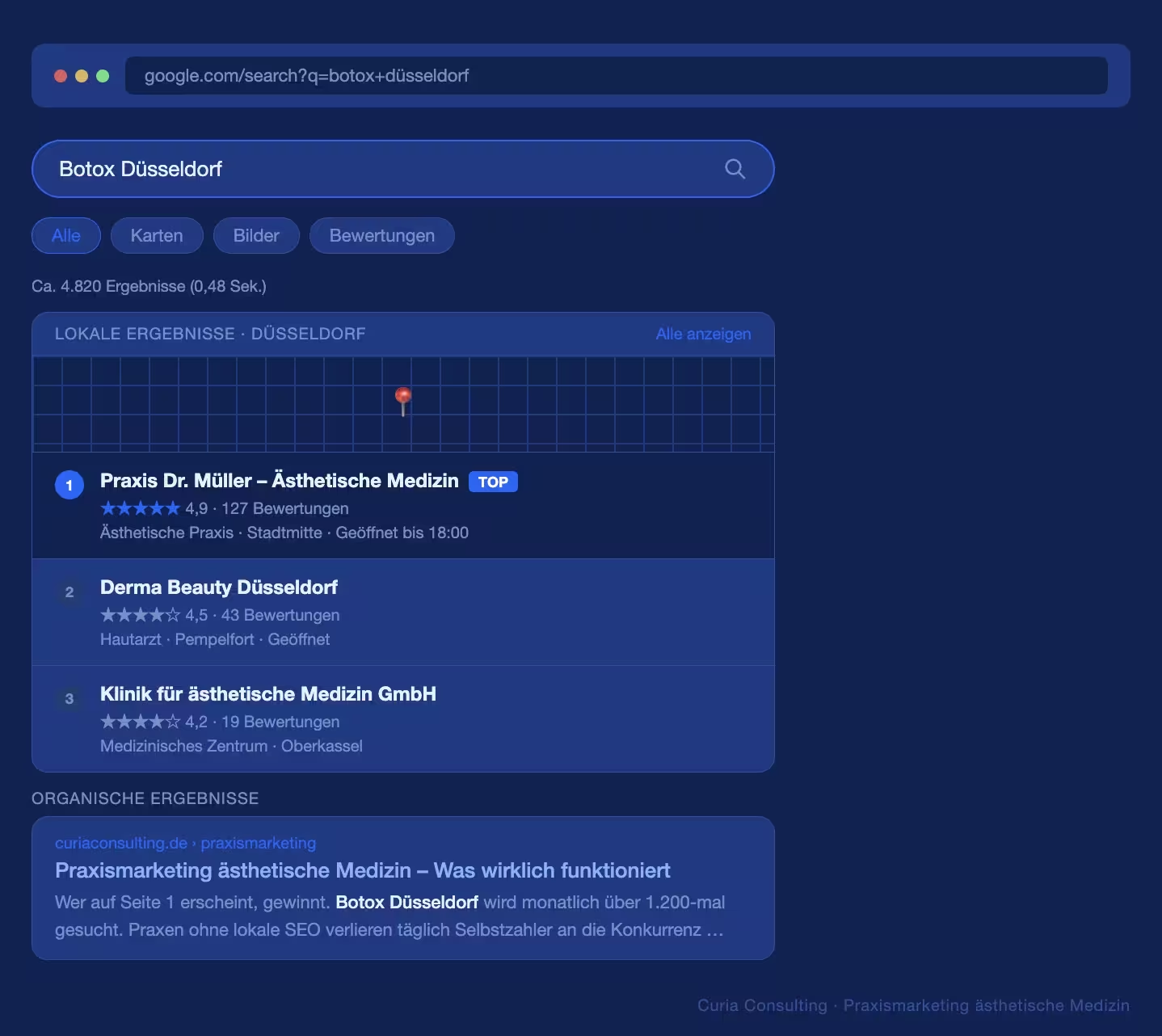
The first point of contact between a target patient and a practice is now, in over 80% of cases, a Google search. If you don't appear on page 1 – ideally in both local results and organic search results – you lose potential patients before you even have the chance to present yourself.
SEO refers to optimizing a website so that it is found more easily on Google and appears as high up as possible.
What actually works: Local SEO with a focus on specific terms – not just "dermatologist Düsseldorf," but "Botox Düsseldorf," "hyaluronic lip filler Cologne," or "thread lift Munich." These are the search terms that self-paying patients use. Add to that a fully maintained Google Business Profile with current photos, service descriptions, and regular posts. Practices with a complete profile receive up to 70% more clicksaccording to Google. And finally, active review management: practices with more than 50 Google reviews and an average rating above 4.7 stars are proven to convert better.
What often fails: general SEO measures without a focus on the practice's specific services. An aesthetic practice that ranks for "doctor" will not win any new self-paying patients.
2. The website as a conversion machine, not a digital business card
Many aesthetic practices have Websites, that look good – but don't attract patients. The reason: They are designed for presentation, not for decision support.
A prospective patient considering treatment has specific questions: How much does it cost? How long is the recovery time? What can I realistically expect? Anyone who answers these questions on their website builds trust – and generates inquiries.
A high-converting practice website includes: treatment-specific subpages with real before-and-after photos (legally compliant), transparent price ranges, a clear online appointment booking system that doesn't require a phone call, a personal physician profile with specializations, and an FAQ section covering the most common treatments. Practices with optimized websites and clear calls-to-action achieve conversion rates of 3–8%. The industry average is less than 1%.
3. Social Media: Building reach, but with a strategy
Instagram and TikTok are more relevant to aesthetic practices than to almost any other medical specialty, because the target audience is actively looking for inspiration and results there. At the same time, social media is the area where the most budget is wasted.
The reality: Organic reach on Instagram is minimal for practices without an existing community. What works instead: targeted paid advertising on Instagram and Facebook with local audience targeting (15–30 km radius, age group, interests) – here, costs per inquiry of 20–80 euros are realistic. This should be combined with treatment videos featuring real patients and consistent posting for at least 6 months.
Important: The German Therapeutic Products Advertising Act (HWG) sets clear limits on before-and-after comparisons and promises of success. Anyone operating here without legal advice risks receiving cease-and-desist orders.
4. Patient retention: The underestimated revenue driver

Acquiring new patients is expensive. A new Inquiry via paid advertising costs aesthetic practices on average 30–120 euros. A referral from an existing patient costs nothing.
Practices that actively invest in patient retentionreport rebooking rates of 40–70% for aesthetic treatments. Concrete measures: structured follow-up 7–14 days after treatment, automated treatment reminders at the right time, and simple referral programs with credits.
5. Use review portals strategically
According to a study by Jameda, 76% of patients rely heavily on online reviews when searching for a doctor. For aesthetic treatments, this figure is even higher – patients conduct more intensive researchbecause the decision is made more consciously.
In addition to Google, Jameda, Doctolib and ProvenExpert play an important role. The strategic approach: maintain a complete profile, actively ask for reviews (ideally immediately after a positive experience using a QR code), and respond to negative reviews professionally and promptly.
6. Choosing the right marketing agency
Many aesthetic practices hire general marketing agencies without experience in the healthcare sector. The result: campaigns that violate advertising laws or SEO efforts targeting the wrong audience.
When choosing an agency, you should look for: proven results in aesthetic medicine, knowledge of the legal framework (advertising laws, professional codes of conduct, GDPR), transparent reporting structures with monthly KPIs, and no minimum contract terms exceeding 12 months.
As a specialized management consultancy for aesthetic medical practices, Curia Consulting combines business practice optimization with targeted patient marketing – no generic solutions, but strategies tailored to the specific dynamics of self-pay patient decisions.
The most common mistakes in practice marketing

1. Relying solely on paid advertising
Google Ads and Meta Ads work – but only as long as the budget lasts. Practices without organic visibility are permanently dependent on rising click costs. In major German cities, the cost-per-click for aesthetic treatments has increased by an average of 40% over the last 3 years.
2. No differentiation from the competition
"We offer Botox, fillers, and laser treatments" – so do 50 other practices in the same city. Practices that do not clearly communicatewhat sets them apart get lost in the competition.
3. Marketing without measurement
If you don't know where your patients are coming from, you cannot optimize your budget. A simple question during the initial contact, combined with Google Analytics and UTM tracking, will provide a clear picture in just a few weeks.
4. Inconsistent branding
A professional website, but outdated Google photos and a half-finished Instagram profile send mixed signals. Patients also judge the diligence of a practice by how well it maintains its own online presence.
Conclusion
Successful practice marketing in aesthetic medicine is not created through individual ads or short-term campaigns, but through a coordinated system of visibility, trust, and patient retention and clear positioning. Those who rely solely on paid advertising remain dependent on rising click costs and lose a large part of their potential.
The key, therefore, is the combination of local search engine optimization, a high-converting website, strategic Social Media, active review management, and professional support for existing patients. Equally important is a clear differentiation from the competition and the consistent measurement of all activities.
Which strategy works best depends on the location, specialty, range of services, and target patients. Practices that take these factors into account and systematically integrate their channels not only attract more new patients but also build long-term a stronger and more economically stable practice.
More patients, less wasted spend.
We work with you to develop a marketing strategy tailored to your practice, your location, and your ideal patients—measurable, legally compliant, and sustainable.
FAQ
Frequently asked questions about practice marketing for aesthetic medicine
Hier finden Sie Antworten auf die wichtigsten Fragen
How much does practice marketing for aesthetic practices cost?
Costs vary depending on the scope and channels. A realistic minimum budget for measurable results is 1,500–3,000 euros per month (agency fee plus advertising budget). Practices in highly competitive cities like Munich, Berlin, or Hamburg often invest 5,000–10,000 euros per month. The decisive factor is not the absolute budget, but the cost-per-inquiry value – for aesthetic treatments, this should be under 100 euros.
How long does it take for practice marketing to show results?
Paid advertising via Google Ads or Meta Ads shows initial results within 2–4 weeks. SEO and organic measures take 3–6 months to have a measurable impact. Practices that combine both channels typically see a significant increase in new patient inquiries after 3 months.
Which treatments are best to market?
Treatments with high search volume and a clear promise of results perform best online: Botox, hyaluronic acid fillers, laser hair removal, and aesthetic dental treatments such as veneers and bleaching. More complex procedures like facelifts or rhinoplasty require longer decision-making processes and benefit more from content marketing and building trust.
Do I need a specialized agency, or is a general marketing agency enough?
For aesthetic medicine, we strongly recommend a specialized agency or consultancy. The legal requirements of the German Advertising Act (HWG) and professional codes of conduct, as well as the specific psychology behind self-pay decisions, require industry expertise that general agencies usually do not possess. Errors in communication can not only be ineffective but can also have legal consequences.
How do I measure the success of my marketing efforts?
The most important KPIs for aesthetic practices are: number of qualified inquiries per month, cost per inquiry, conversion rate from inquiry to initial consultation, patient retention rate, and the percentage of new patients acquired through referrals. If you know these five figures and track them monthly, you can optimize your marketing in a targeted way.