
28.08.2026
The perfect landing page for aesthetic treatments: How to convert website visitors into patients
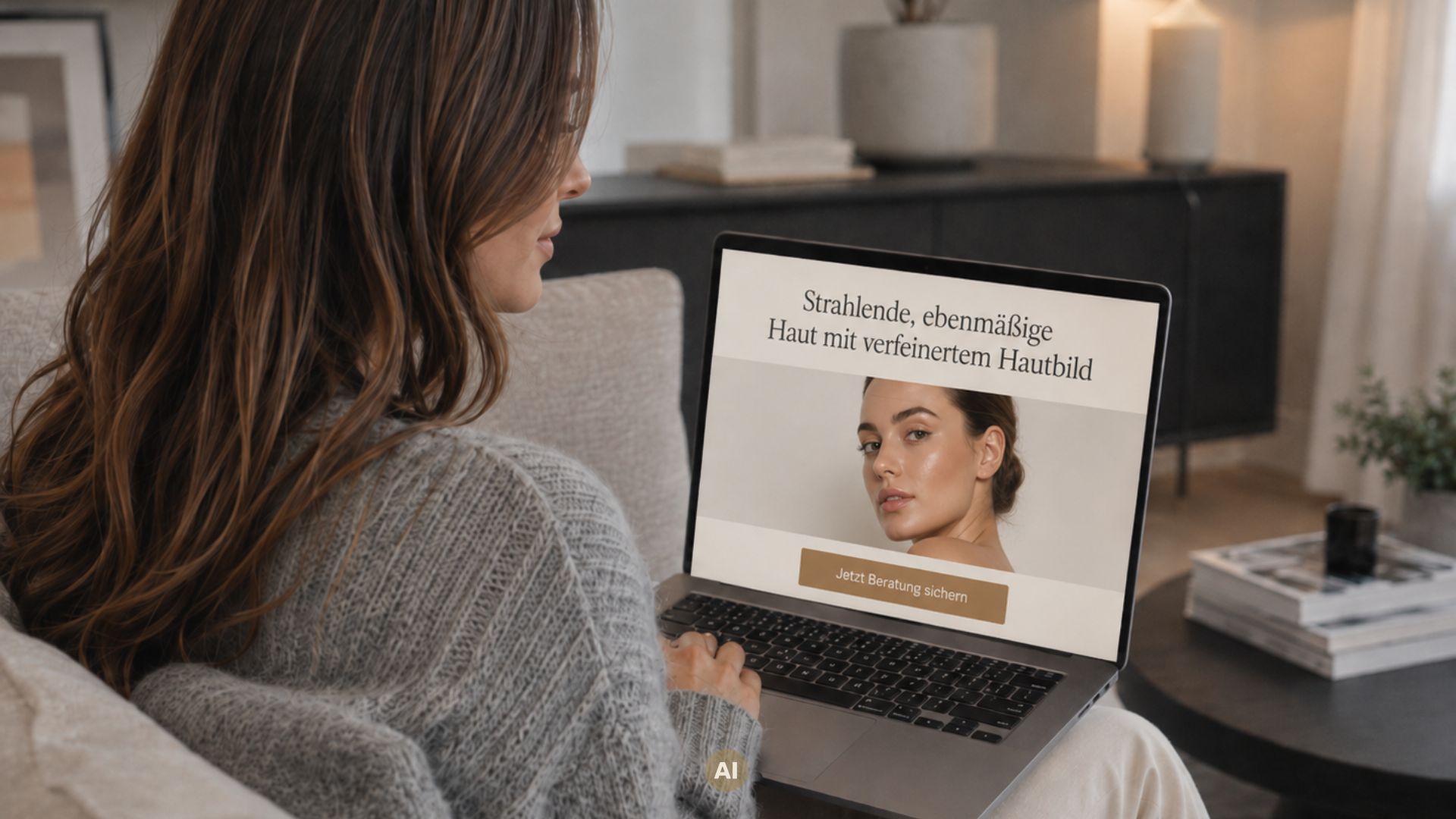
Are you investing in advertising for your aesthetic practice, but not getting enough inquiries from website visitors? The problem often lies not in the campaign, but on the landing page. This article shows you which elements effectively guide visitors to book an appointment.
Felix Ixkes
Key takeaways
- A landing page has one clear goal: to guide the visitor as directly as possible to an inquiry or appointment booking.
- Headlines, social proof, doctor profiles, objection handling, and repeated CTAs build trust and reduce uncertainty.
- Mobile optimization, fast loading times, and A/B testing are key factors in how efficiently your advertising budget actually performs.
Your Google Ads campaign brings a steady stream of visitors to your website, yet the contact form remains largely empty. The obvious reaction is to adjust your ads or budget. However, the real bottleneck is often one step further: on a landing page that provides information but fails to consistently drive inquiries.
The core problem: websites inform, landing pages must convert
The critical misconception for many medical practice websites is this: they are built as information hubs , not as conversion tools. When someone visits the website of an aesthetic practice, they often find a general overview of services, a team page, a brief text about the practice's philosophy, and a phone number or contact form tucked away somewhere on the side.
That may work as a digital business card. As a conversion tool , it does not.
A landing page – unlike a general website – pursues exactly one goal: to encourage the visitor to take the next step. Just this one step. Not two, not five. One. In aesthetic medicine, this step is usually booking a consultation or making an inquiry by phone.
Everything on the page – structure, language, images, buttons – must serve this single goal. Anything that does not serve this goal is a distraction and costs you conversions.
The psychological framework: How patients make decisions

Before explaining the specific structure, it is important to understand why people convert on a landing page – or why they don't. Someone who clicks on an ad for laser treatment or hyaluronic acid injections is in a specific emotional state: They have a problem that is weighing on them. They are looking for a solution. But they are still uncertain.
This uncertainty is the decisive psychological factor. It manifests in questions that the visitor – consciously or unconsciously – wants answered before they make an inquiry:
Is this practice the right one for me? Can I trust the doctor? Will I get the result I’m imagining? What happens when I call? Do I have to commit immediately?
A well-structured landing page answers all these questions – in the right order, with the right elements. It guides the visitor step by step through a psychological process that builds trust, removes objections, and ultimately makes the decision easier.
The structure of the perfect landing page: Element by element
1. The headline: Relevance in three seconds
Visitors decide within the first three secondswhether they stay or leave. The headline is the only element that is reliably read during this time. It must accomplish two things simultaneously: signal relevance and spark interest.
A good headline for an aesthetic medicine landing page addresses the visitor's problem or desire directly — not the practice or the treatment. The difference is crucial.
❌ Weak headline: "Welcome to the Dr. Müller practice – your specialist for aesthetic medicine in Munich"
✅ Strong headline: "Firmer skin without surgery – Book your consultation now"
The strong The headline addresses the resultthat the visitor wants. It is specific, solution-oriented, and already contains an implicit call to action. Most importantly: If a visitor arrives via an ad promoting a specific treatment, the headline on the landing page must address that exact treatment. Any discrepancy between the ad and the landing page—even a subtle one—dramatically increases the bounce rate.
2. The subtext: Benefit-oriented communication
Below the headline follows a short subtextthat highlights the key benefits of the treatment or the practice concisely and concretely. Not features—benefits. The difference: A feature is a characteristic of the treatment. A benefit is the value for the patient.
- Feature: "We use state-of-the-art radiofrequency technology"
- Benefit: "Visible tightening after just the first session—with no downtime"
The visitor is not interested in the technology. They are interested in the result they get—and in what they does not have to endure: no surgery, no long downtime, no major risk.
3. The first call to action: Early and visible
A CTA (call to action) is a clear prompt designed to guide the reader toward the next step, such as booking an appointment or getting in touch.
The first call to action (CTA) should be visible at the top of the page without the visitor needing to scroll. If someone is already convinced after reading the headline, they should be able to act immediately.
The CTA must be specific and low-barrier . "Contact" is not a good CTA. "Book your free consultation now" is better. "Secure your appointment in 60 seconds – free and no-obligation" is even better.
The word "no-obligation" has a special psychological effect in aesthetic medicine: it removes the fear of commitment. Many prospective patients hesitate not because of the procedure itself, but because they fear that making an inquiry means they are already locked in. This fear must be actively addressed.
4. Social Proof: Building trust through evidence
Following the first CTA, it is time to build trust through systematic social proof. Visitors want to know that others have been here and were satisfied. Only then are they ready to take the next step themselves.
Effective social proof elements in aesthetic medicine include:
- Google reviews: Star ratings, the number of reviews, and specific feedback regarding treatments build trust and make quality tangible.
- Patient testimonials: Personal accounts in video or text format are particularly powerful when they describe specific experiences and results.
- Awards, certifications, and professional memberships: These highlight professional expertise and strengthen confidence in the practitioner.
- Treatment volume and practice statistics: Details such as "Over 2,000 treatments performed" or "Serving Munich for 12 years" convey experience and continuity.
- Before-and-after galleries: According to current Federal Court of Justice (BGH) rulings, these are prohibited in public advertising and on websites for aesthetic treatments. Legally compliant alternatives include patient videos that do not feature comparative body imagery, specific testimonials, and result photos shown during the medical consultation.
5. Positioning as an expert: Who is treating me?
A frequently underestimated element on landing pages in aesthetic medicine is the personal introduction of the treating physician. Patients do not book treatments; they book people. Choosing an aesthetic practice is always a choice for a person to whom you entrust your body and your confidence.
A brief, personal introduction of the practitioner – including a photo, qualifications, specialization, and an authentic statement about their treatment philosophy – measurably increases the conversion rate. The rule here is: authenticity beats high-gloss. A natural photo and an honest text build more trust than an overproduced, high-gloss portrait that lacks a personal connection.
6. Handling objections: Actively addressing fears
Many visitors who leave a landing page without inquiringdo not do so because they lack interest, but because an unanswered question or an unspoken fear is holding them back. The most common objections in aesthetic medicine are predictable:
- Pain and discomfort: "Does it hurt?"
- Downtime: "How long will I be unable to work or go out afterwards?"
- Natural-looking results: "Will people be able to tell?"
- Costs: "How much does it cost – and is it worth it?" Risks: "What could go wrong?"
A well-structured landing page addresses these objections proactively – in an FAQ section, in short text blocks below the treatment process, or through patient testimonials that answer these exact questions. By identifying and dispelling a fear before the visitor even has to ask, you demonstrate both empathy and expertise.
7. The treatment process: Making the procedure transparent
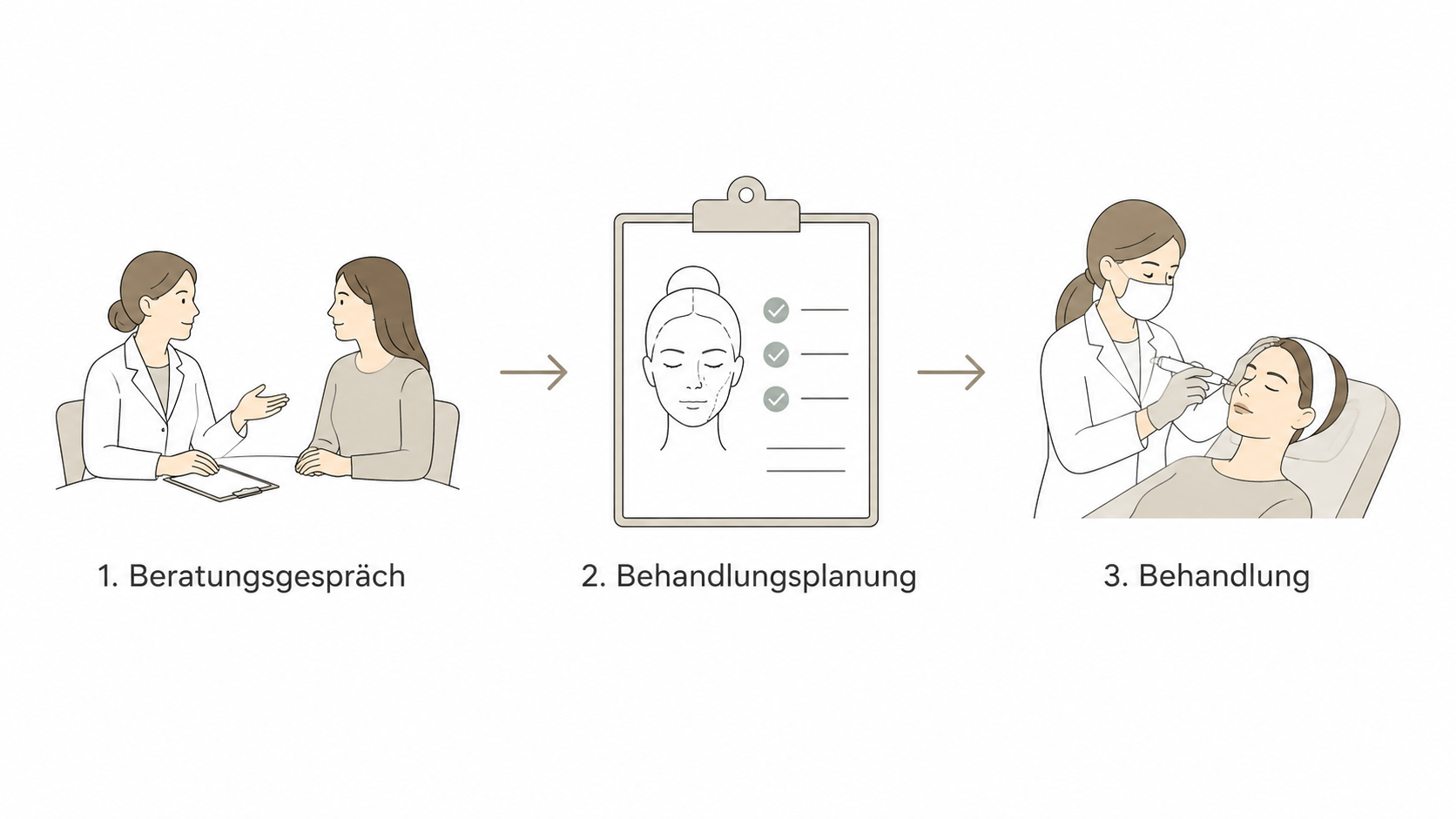
One of the most effective ways to reduce anxiety is to provide a transparent overview of the treatment process. Many prospective patients hesitate not because of the procedure itself, but because of the uncertainty: What happens when I call? What can I expect at the first appointment? How does the treatment work?
8. FOMO: Creating the right moment
FOMO – Fear of Missing Out – is a powerful psychological triggerthat can be used carefully in aesthetic medicine. Not through aggressive countdown timers or manufactured scarcity, but through honest communication about availability: "Consultation appointments are currently limited" or "Next available slots: this week" are legitimate and effective phrases, provided they reflect reality.
Also effective: seasonal references. "Get treated in time for summer" addresses a real motivation and creates an impulse to act without manipulative exaggeration.
9. Repeated CTAs: Being present at every decision point
A common mistake is the single CTA at the bottom of the page. Visitors do not read landing pages linearly from top to bottom – they jump around, scan, and make decisions at different points. A CTA must therefore be visible at each of these decision points: after the headline, after the social proof block, after the expert introduction, and at the end of the page.
The wording of the CTAs can vary – but the goal remains the same: book a consultation. There must always be the simplest possible path to this goal. One click, one Form with a maximum of three fields, a phone number that is immediately visible. Every additional hurdle costs conversions.
10. Technical fundamentals: loading speed and mobile-first
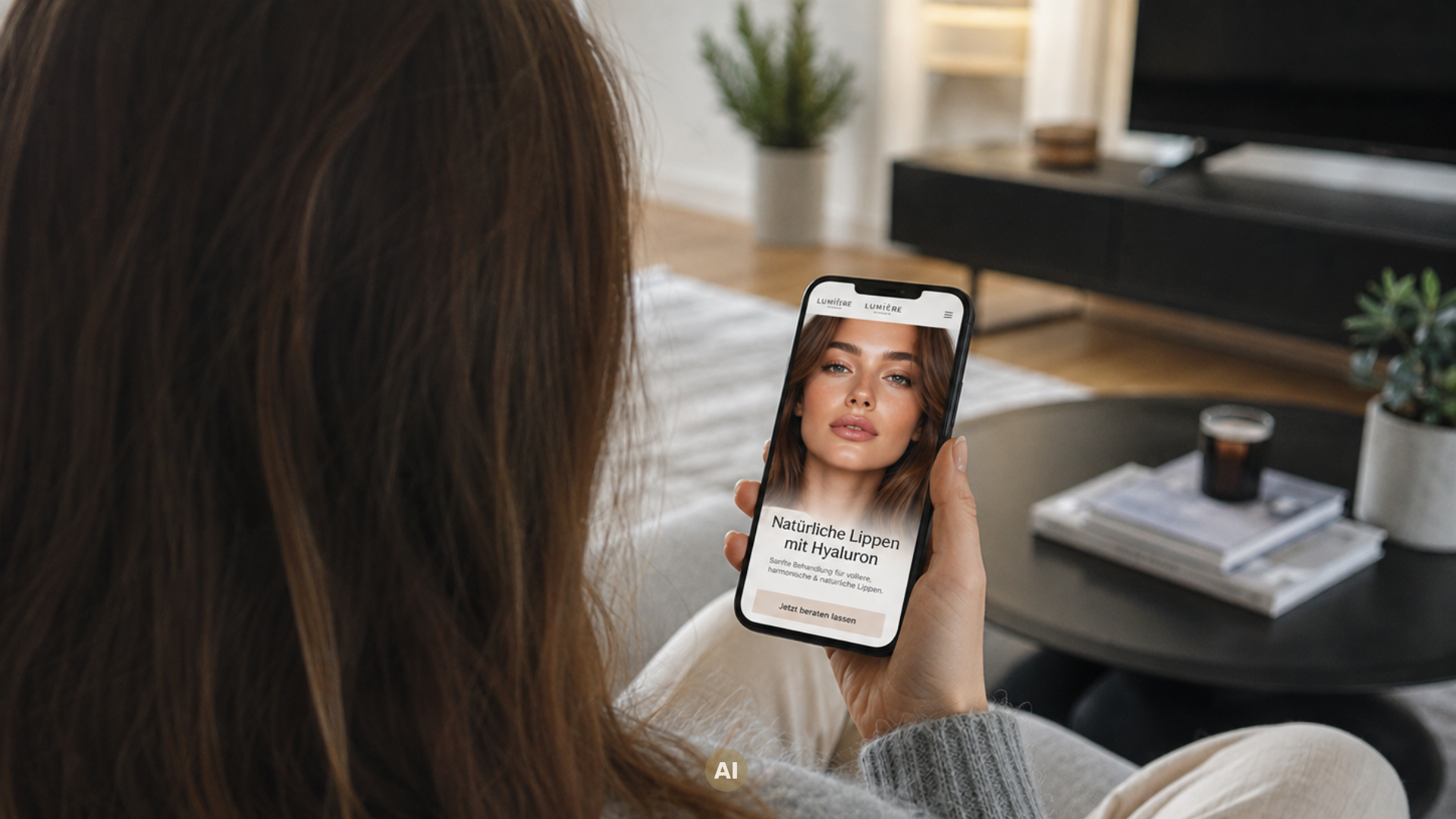
A perfectly written landing page that takes three seconds to load will lose a significant portion of its visitors before they even read the first word. Loading speed is not just a technical detail – it is a conversion factor. More than half of the traffic on aesthetic practice websites now comes from mobile devices. A landing page that looks good on a desktop but is unreadable or slow to load on a smartphone is, for a large part of the target audience, effectively non-existent.
Mobile-first is not a trend, it is a requirement.
A/B testing: The only method that truly matters
What works on a landing page depends on your target audience, region, treatment, and brand. That is why A/B testing is crucial: It involves testing only one single element at a time, such as a headline, CTA, or form.
Particularly relevant elements include headlines, CTA wording, social proof, form fields, and page length. This allows you to optimize your landing page step-by-step based on data, rather than gut feeling.
Conclusion
The landing page is the heart of every digital patient acquisition strategy. Driving traffic to a page that isn't optimized for conversion means wasting a large portion of your marketing budget. A landing page that works is no accident—it is the result of a clear structure, psychologically sound communication, systematic social proof, and continuous testing.
Headlines, benefits, social proof, expert positioning, objection handling, repeated CTAs, and a simple booking process—each of these elements serves a specific function on the journey from the first click to a booked consultation. Together, they form a system that doesn't just inform visitors, but guides them toward a decision.
Curia Consulting develops and optimizes landing pages for aesthetic practices and clinics in the DACH region—data-driven, legally compliant, and consistently focused on generating patient inquiries.
Does your landing page turn clicks into patients?
A good campaign brings visitors to your website—a strong landing page turns them into qualified inquiries. We analyze your existing page and show you where you are currently losing potential.
FAQ
Frequently Asked Questions about Landing Pages for Aesthetic Practices
Hier finden Sie Antworten auf die wichtigsten Fragen
What is the difference between a landing page and a standard website?
A website is a general information hub with many pages, navigation menus, and various objectives. A landing page has one single goal—usually a specific action like an appointment request or a phone call. Everything on the page is focused on that one goal. Landing pages typically lack full navigation, distracting links, and general content.
How long should a landing page for aesthetic treatments be?
There is no one-size-fits-all answer—the optimal length depends on the treatment, the target audience, and the traffic source. As a rule of thumb: the more explanation a treatment requires and the higher the investment for the patient, the longer the page can and should be. For well-known treatments like Botox, a shorter page may suffice. For more complex or expensive procedures, you need more social proof, more education, and more objection handling—and therefore more content.
How many fields should the contact form have?
As few as possible. Experience shows that forms with more than three or four fields significantly reduce conversion rates. Name, phone number, and optionally the desired treatment are perfectly sufficient for an initial inquiry. Further information can be gathered during the preliminary phone consultation.
Do I need a separate landing page for every treatment?
Yes—at least for every treatment you are actively advertising. A landing page trying to promote Botox, fillers, Morpheus8, and laser treatments all at once cannot be truly relevant to any of them. If you run an ad for a specific treatment, you must direct visitors to a page that focuses exclusively on that treatment.
What is a good conversion rate for an aesthetic medicine landing page?
A solid conversion rate is generally considered to be two to five percent of page visitors submitting an inquiry, depending on the traffic source, treatment, and the practice's market position. Well-optimized landing pages in aesthetic medicine can achieve rates of five to ten percent or more. If you don't know your current rate, you should start measuring it before you begin optimizing.