
31.07.2026
AI visibility for aesthetic medicine: recommended by ChatGPT
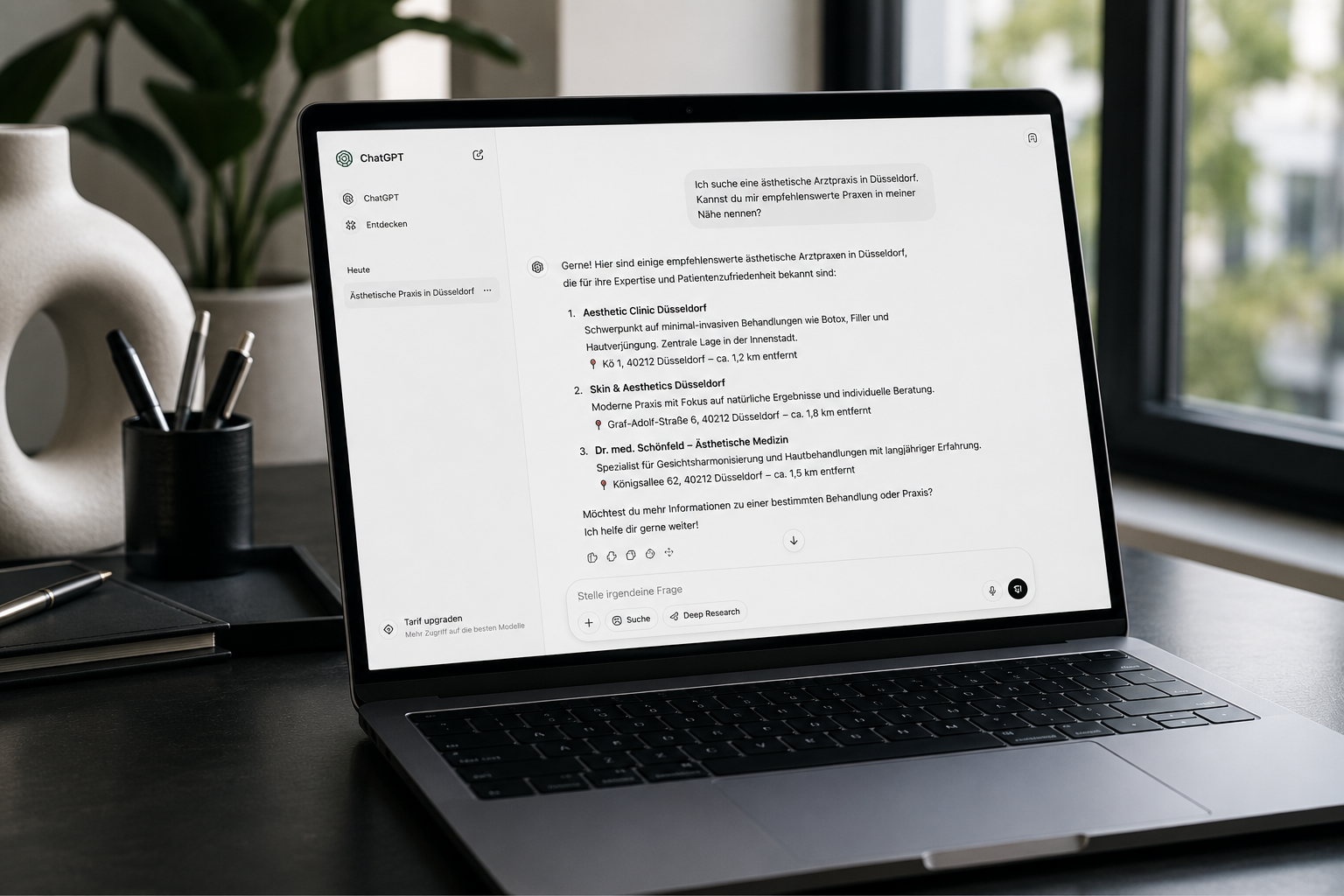
Do you want your practice to be not only found on Google but also recommended by ChatGPT and other AI systems? Many practices continue to invest exclusively in traditional search engine optimization, overlooking the fact that AI systems select their recommendations based on different criteria. This article shows you how AI visibility is created, the role played by professional content, external mentions, and consistent practice data, and how you can build your digital authority step by step.

Georg Hutzschenreuter
Key takeaways
- AI systems don't just evaluate your website; they assess the entire digital footprint of your practice – from professional articles and reviews to industry portals, videos, and external mentions.
- Traditional SEO remains important, but it is no longer enough on its own. Achieving AI visibility requires an additional layer of consistent presence, clearly recognizable expertise, and machine-readable content.
- Digital authority is not built overnight. A well-maintained Google Business Profile, high-quality professional content, and external trust signals create a sustainable competitive advantage over several months.
A patient no longer searches Google for a practice; instead, they ask ChatGPT for a specialized provider in their area. Your practice has a modern website and offers excellent medical services, yet it isn't mentioned in the response. Instead, competitors appear who regularly publish professional content, are cited on multiple portals, and provide consistent information across all channels. It is precisely in these situations that it becomes clear why traditional visibility is no longer sufficient.
What is AI visibility?
AI visibility describes how frequently and prominently a medical practice appears in the responses of AI systems such as ChatGPT, Perplexity, or Google’s AI Overviews. While traditional search engine optimization focuses on ranking as high as possible in a list of links, this is about being directly cited by an AI as a trusted recommendation .
The key approach is Generative Engine Optimization (GEO) – the evolution of traditional SEO for generative AI systems, which are software programs that formulate their own answers rather than simply displaying links.
The practical added value lies in the fact that an AI recommendation comes with a high level of inherent trust . When someone receives a recommendation for a practice from ChatGPT, they perceive it as a neutral recommendation, not as advertising. AI visibility for medical practices thus becomes a channel of trust that is rapidly growing in importance as AI search becomes more widespread—especially among younger patients who already use these tools as a matter of course.
It is important to address a common misconception: AI visibility is not a one-time technical project that can be completed, but rather a continuous process of building credibility. It is not achieved through a trick or a single optimized page, but through the consistent overall impression that a practice leaves in the digital space over time.
How AI search engines select sources
To understand AI visibility, it helps to look at where AI systems get their answers. Simply put, there are two sources.
- Training knowledge: Content that the model has learned from vast amounts of text during its development.
- Live research: The system retrieves current content from the internet and incorporates it into the answer.
For a practice, this means: visibility is not created by a single optimized document, but by the existence of a consistent, trustworthy image across many sources. The more frequently and consistently a practice appears in accessible material, the more likely an AI system is to use it as a source.
The key factors for visibility in AI answers
Several factors increase the likelihoodbeing mentioned by AI systems. They all contribute to the same metric: digital authority, which is the credibility of a practice as recognized across many sources.
- High-quality professional content
Well-structured and professionally sound content helps AI systems correctly categorize a practice and include it in their responses.
- Mentions and external sources
Professional articles, interviews, and industry portals strengthen credibility by acting as independent validation.
- Video and YouTube
Professional videos with descriptions and transcripts increase visibility and make medical expertise accessible to AI systems.
- Lists and rankings
Being mentioned in reputable practice lists and rankings increases the likelihood of being cited in AI responses.
- Expert status and consistent presence
Publications, lectures, podcasts, and a consistent presence across all channels strengthen expert status and trust.
Check and measure AI visibility

AI visibility is harder to measure than a traditional search ranking, but it is not invisible. A simple first test is to ask AI systems directly for recommendations in your region and area of specialization, and observe if and how your practice is mentioned. These spot checks provide an initial impression of your current standing.
Furthermore, it is worth tracking the development of external mentions and observing whether inquiries are increasingly stemming from AI recommendations – many patients now mention this voluntarily. Since AI systems change rapidly, measurement is less of a one-time snapshot and more of an ongoing observation over time.
A realistic roadmap for the first few months
When starting with AI optimization, you should not tackle everything at once . It makes sense to follow a sequence: First, secure the fundamentals – a complete Google Business Profile, consistent information across all directories, and a technically sound, clearly structured website. This foundation also benefits traditional search results.
The second step involves creating regular, high-quality expert contentthat answers common patient questions. Only once this is in place is it worth building external visibility through mentions, videos, and expert formats. This process is a marathon, not a sprint: Digital authority is built over months. Those who start early and stay consistent secure a competitive advantage over practicesthat still rely exclusively on traditional SEO.
Common mistakes in AI optimization
When building AI visibility, several mistakes occur particularly often:
Focusing solely on your own website
Those who only optimize their website ignore external mentions, which often carry more weight for AI systems.
Content without a clear author
Anonymous or generic texts provide no signals of trust. Clearly identifying professional accountability is crucial, especially for medical topics.
Inconsistent information
Discrepancies in addresses, names, or services across different directories undermine your credibility.
Promotional rather than professional language
Sensationalist claims damage your authority and may conflict with healthcare advertising regulations.
Impatience and reactive behavior
Digital authority is built over months. Isolated actions without a sustained strategy will fail to gain traction.
What you cannot control – and how to handle it
Despite all optimization efforts, one limitation remains: exactly how an AI system describes a practice cannot be directly controlled. Unlike with an advertisement, there is no switch to guarantee a specific phrasing. Furthermore, AI systems may shorten information or, in the worst case, present it inaccurately—a phenomenon known as hallucination.
The best way to handle this is twofold. First, you can influence the foundation: The clearer, more accurate, and more consistent your information is across all sources, the lower the risk of incorrect output. Second, it is worth investing in a regular monitoring, by checking at intervals how AI systems represent the practice, in order to be able to react to major errors.
It is also helpful to provide the most important facts about the practice in a prominent, easily accessible place — such as a clear description of the areas of focus, the location, and the people in charge. The more clearly this core information is available, the less frequently systems will rely on outdated or incorrect details.
Combining AI visibility and traditional advertising
AI visibility and paid advertising follow different logics and complement each other precisely for that reason. Advertising via Google or social media works immediately, but it costs money continuously and stops as soon as the budget runs out. AI visibility builds up slowly, but then remains in place and incurs no costs per query.
A practice that relies solely on advertising is renting its visibility; a practice that also focuses on digital authority is building equity.
Therefore, a combinationis sensible: advertising ensures predictable patient flow, while simultaneously AI-driven visibility grows. Over time, the share of expensive paid leads can decrease as more patients find the practice on their own through search and AI recommendations. This shift reduces long-term dependence on advertising budgets and makes growth more resilient.
Conclusion
AI visibility for medical practices is becoming a critical channel, as more and more patients find their providers through AI systems rather than traditional search. To be featured there, you must think beyond your own website: high-quality specialist content, external mentions, a well-maintained Google Business Profile, machine-readable content, expert status, and a consistent presence build the digital authority that AI systems reward. Building this takes patience, but it provides a competitive edge exactly where the next generation of patient decisions is being made.
Become visible where patients will be searching in the future
We help aesthetic practices build their digital authority strategically—with a comprehensive approach to SEO, GEO, and AI visibility.
FAQ
Frequently asked questions about AI visibility for aesthetic medicine practices
Hier finden Sie Antworten auf die wichtigsten Fragen
What exactly does GEO mean?
GEO stands for Generative Engine Optimization, which is the optimization for generative AI systems that formulate their own answers. While traditional SEO aims for high rankings in link lists, GEO ensures that a practice is cited directly as a trusted source in AI-generated responses.
Does GEO replace traditional SEO?
No. They complement each other. Traditional SEO remains important for visibility in Google search, while GEO addresses visibility in AI answers. A combined strategy that covers both levels is the most effective approach.
How quickly does AI optimization take effect?
Digital authority is built over months, not days. While individual high-quality pieces of content or mentions can have a relatively quick impact, a stable presence in AI responses is the result of continuous work over an extended period.
Can a practice check for itself whether it appears in AI systems?
Yes. A simple test is to ask ChatGPT, Perplexity, or Google AI directly for recommendations in your specific region and specialty. This shows whether and how prominently your practice is mentioned, providing an initial snapshot of your current standing.
Are AI recommendations legally safe for practices?
The content that makes a practice visible must comply with advertising regulations for medical services—factual information is fine, but sensationalist promises of a cure are not. While you cannot directly control how an AI refers to your practice, you can control the quality and legal compliance of your own content.
Which measure has the greatest impact?
In most cases, high-quality, regularly published professional content combined with external mentions is most effective. Together, these build the digital authority that AI systems require to provide a recommendation.