
26.06.2026
Google Ads vs. Meta Ads in Aesthetic Medicine – A Direct Comparison
Are you looking to attract more patients to your aesthetic practice through paid advertising, but are unsure whether to invest your budget in Google Ads or Meta Ads? Both platforms reach potential patients at different stages of their decision-making process and therefore serve different purposes. This article shows you how Google and Meta differ, how both channels work together, and the criteria for allocating your advertising budget effectively.

Javid Safaei
Key Takeaways
- Google Ads primarily reach people who are already actively searching for a treatment or a practice, while Meta Ads generate awareness early on and build new demand.
- The most powerful impact comes from the interaction between both channels: Meta sparks interest, Google captures the subsequent search, and remarketing brings undecided prospects back into contact with your practice.
- There is no one-size-fits-all budget split. Your region, competition, range of treatments, positioning, and the development stage of your practice determine how heavily you should weight the individual platforms .
A potential patient sees a video about skin tightening on Instagram in the evening. She doesn't click, but she remembers the treatment. A few days later, she searches on Google for a suitable practice nearby and books an appointment. To the practice, it looks as if Google alone generated the lead. In reality, however, the decision-making process began with the ad on Meta. Cross-channel patient journeys like this are a standard part of aesthetic marketing today.
Google Ads: High purchase intent, high competition

Google is a search engine. That sounds obvious, but it is the crucial strategic starting point: anyone who sees an ad on Google has actively searched for something. The user has already expressed an intent – they want to find, compare, or book something.
For aesthetic practices, this means: Google Ads reach people who are already in an advanced stage of their decision-making journey . Someone who types "Botox Düsseldorf" or "hyaluronic acid treatment Munich" into the search bar has a concrete interest and is actively looking for a provider.
The strengths of Google Ads in aesthetic medicine:
- Reaches patients with concrete, active purchase intent
- Local targeting possible at city or district level
- Measurable Performance via conversion tracking and call tracking
- Fast results with well-structured campaigns
- High relevance for specific treatments using known search terms
The decisive disadvantage: Google Ads are expensive. In the field of aesthetic medicine, cost-per-click ranges between three and twenty euros per click – and even higher for competitive keywords like "facelift" or "liposuction." Anyone running ads without an optimized landing page and a clear conversion process will quickly pay high prices for minimal results.
Meta Ads: No search intent, but superior targeting
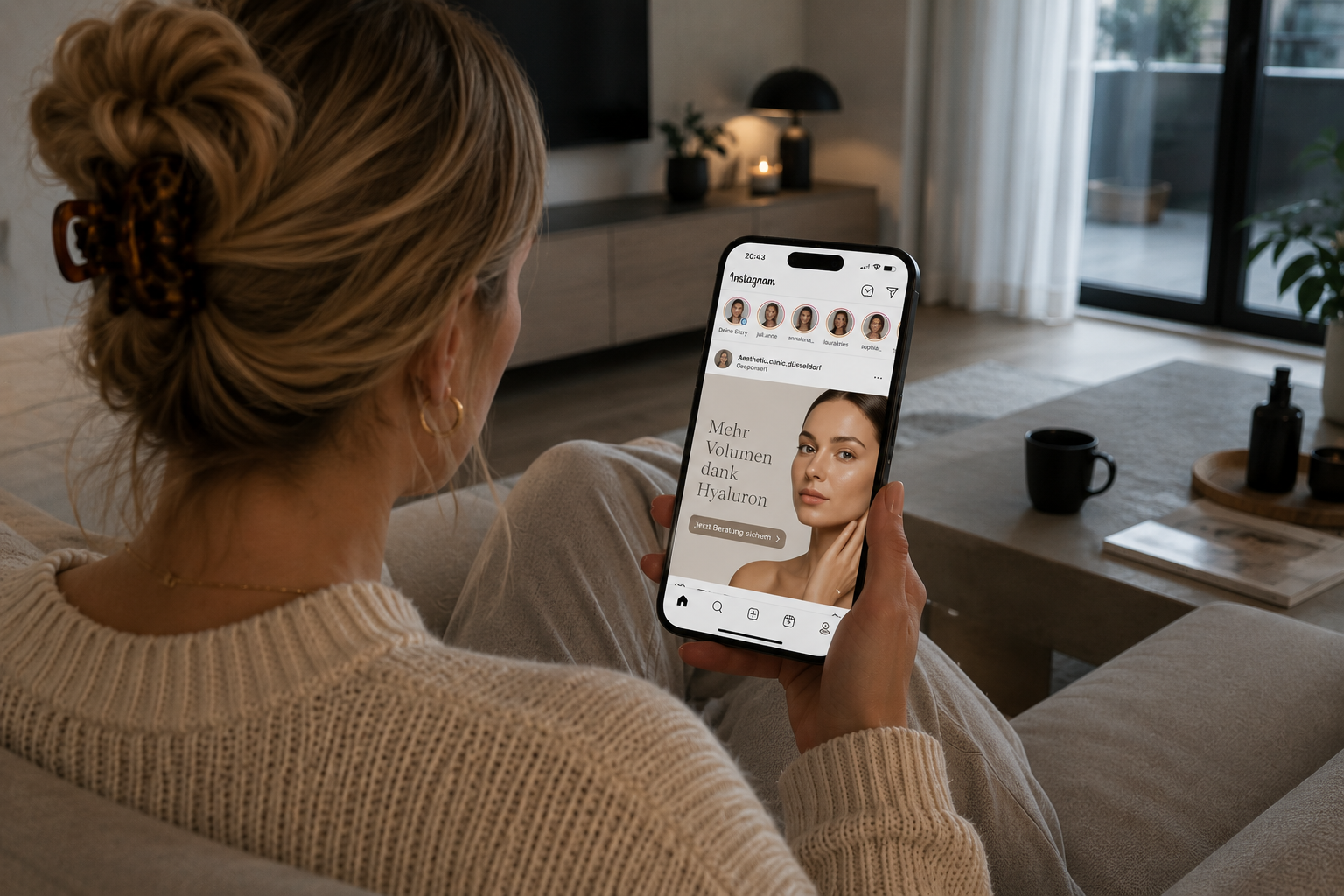
Meta – meaning Facebook and Instagram – operates on a fundamentally different principle. No one opens Instagram to search for a Botox provider. Users scroll through their feed, consume content, and are presented with Advertising confronted with content tailored to their profile, behavior, and interests .
At first glance, this is a disadvantage: there is no active purchase intent. The user wasn't searching for anything. But this is precisely where the strategic strength of Meta lies – targeting.
Meta possesses one of the most precise audience targeting systems in the world. Aesthetic practices can deliver their ads based on age, gender, location, interests, behavior, purchasing power, and hundreds of other signals. Furthermore, Custom Audiences enable the targeted engagement of individuals who have already visited the website, started but not submitted a form, or belong to a specific engagement group on Instagram.
The strengths of Meta Ads in aesthetic medicine:
- Precise demographic and interest-based targeting
- Ideal for visually compelling treatments with high creative potential
- Reaches patients in early stages of awareness – generates demandbefore it even exists
- Significantly lower cost-per-click than Google in many segments
- Building brand awareness and trust over time
The structural advantage of Meta is that the channel doesn't just reactively capture existing demand, but actively creates new demand. A woman in her mid-forties who has never specifically looked into skin tightening becomes aware of the topic through a well-made Instagram Reel – and searches for a provider on Google three days later.
Why both channels belong together
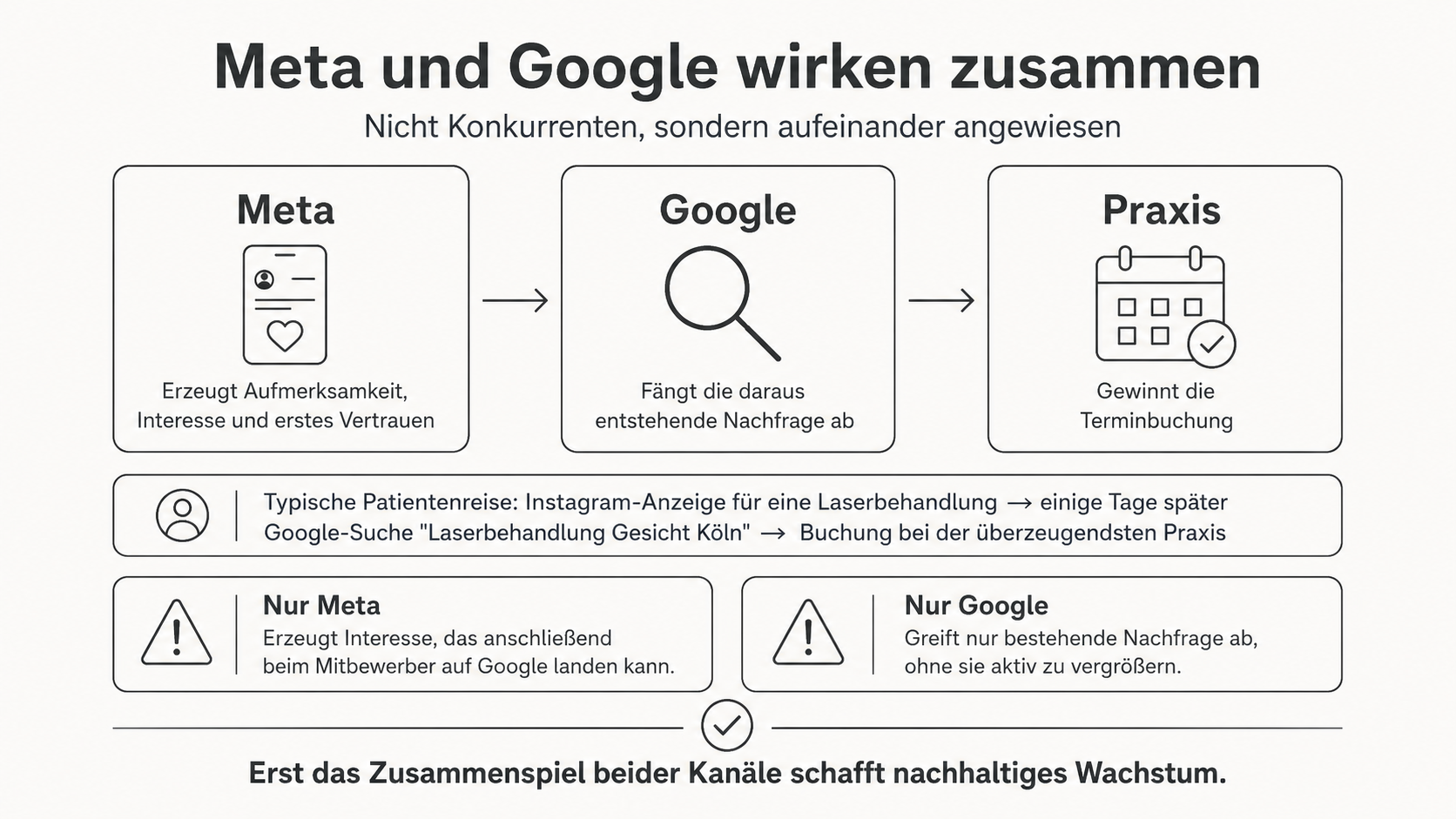
The most important strategic connection that many practices don't know about or underestimate: Meta and Google are not competitors, but rely on each other.
Meta generates awareness, interest, and initial trust. Google captures the resulting demand . The typical patient journey in aesthetic medicine today often looks like this: A prospective patient sees an Instagram ad for a laser treatment, scrolls past, but keeps thinking about it. A few days later, they Google "laser treatment face Cologne" – and book with the practice whose Google ad or organic result convinces them first.
Practices that only run Meta ads generate interest that subsequently lands with a competitor on Google. Practices that only run Google ads merely capture existing demand – without actively growing it. Both strategies are suboptimal.
Diversification as risk management
Another, often underestimated reason for using both platforms is the business risk of channel dependency.
Practices that rely exclusively on Meta are completely at the mercy of a single company and its algorithmic decisions. Account suspensions, policy changes , or sudden spikes in CPM can bring the entire flow of patients to a standstill overnight. The same applies in reverse to a Google-only strategy.
In marketing, CPM stands for "cost per mille" and describes the cost incurred to achieve 1,000 views or impressions of an ad.
Those who run both channels in parallel create two independent acquisition pillars. If one channel temporarily fails or performance dips, the other compensates. In aesthetic medicine, where acquiring new patients directly impacts monthly revenue, this is a strategic necessity.
The right budget split
One of the most common questions is: What percentage of the budget should go to Google, and how much to Meta? The honest answer is: There is no universal split. The optimal distribution depends on several practice-specific factors.
These four factors are particularly decisive:
1. Region and competition
In large cities, Google click prices for aesthetic treatments are often particularly high. In those cases, a larger Meta share can be more cost-effective. In regions with less competition, Google often works more efficiently.
2. Positioning of the practice
Visually striking practices with a strong Instagram presence and compelling results usually benefit more from Meta. Practices with many Google reviews, good local visibility, and an established reputation should prioritize Google.
3. Treatment Portfolio
Well-known treatments like Botox, hyaluronic acid, or laser hair removal are actively searched for and are therefore well-suited for Google. Newer offerings or those requiring explanation, such as Morpheus8, Ultherapy, or longevity programs, often need to be introduced via Meta first.
4. Practice Development Stage
New practices should focus more on Meta to build awareness. Established practices with existing demand can use both channels in a more balanced way.
As a rough guideline, growth-oriented practices should aim for a ratio of 60 percent Meta to 40 percent Google. However, it is crucial to regularly review and adjust this distribution based on the patient acquisition costs for each channel.
Conclusion
Google Ads and Meta Ads are not alternatives, but complementary channels with different strengths. Google captures existing intent—precise, expensive, and effective in the decision-making phase. Meta generates demand through targeted advertising—more affordable, visual, and powerful in the early stages of awareness. Their interaction is the real driver: Meta users become Google searchers. Those who systematically combine both channels diversify their risk and lower their PAC in the long term.
PAC stands for "Patient Acquisition Cost" and describes the average marketing and sales costs incurred to acquire a new patient for an aesthetic practice or clinic.
Curia Consulting develops cross-channel performance marketing strategies for aesthetic practices and clinics in the DACH region—legally compliant, data-driven, and focused on sustainable practice growth.
Sustainable marketing scaling for growing aesthetic practices
Not all growth phases require more budget—they require a smarter strategy. Together, we will make your patient acquisition reliable and scalable.
FAQ
Frequently asked questions about Google Ads and Meta Ads in aesthetic medicine
Hier finden Sie Antworten auf die wichtigsten Fragen
Which platform is better for getting started–Google or Meta?
For those just starting out, Meta is recommended if the practice does not yet have an established local search presence. Entry costs are lower, audience targeting is more flexible, and building brand awareness is faster. Once a foundation of marketing data and custom audiences has been established, Google should be added in parallel.
What does a lead cost via Google Ads in aesthetic medicine?
This varies significantly depending on the region, treatment, and campaign quality. As a benchmark, the cost per qualified inquiry via Google Ads in aesthetic medicine often ranges between 30 and 120 euros. With effective campaign management, lower costs per lead are often achievable via Meta—though typically with a lower conversion rate, as the search intent is absent.
Am I allowed to advertise aesthetic treatments on Meta?
In principle, yes—with significant restrictions. Meta has its own advertising policies for health-related topics, which, among other things, restrict certain before-and-after depictions, body-focused language, and medical claims. In addition, the German Therapeutic Products Advertising Act (HWG) and professional legal requirements apply. Ads that are not compliant with the HWG are not only legally risky but are also often algorithmically deprioritized by Meta.