
19.06.2026
The 5 biggest mistakes in practice marketing – and how aesthetic practices can avoid them
Are you investing in marketing for your aesthetic practice, but not seeing the inquiries and appointments you expected? This is often not due to your budget or the quality of your treatments, but rather to strategic, technical, or legal errors. This article highlights the five most common mistakes in aesthetic marketing, their consequences, and how you can specifically optimize your efforts to use your budget more efficiently and attract more patients sustainably.

Georg Hutzschenreuter
Executive summary
- It is not the size of your advertising budget that determines your success, but the interplay of legally compliant communication, an optimized website and a clear target group strategy.
- Advertising campaigns require sufficient time and data. If they are ended too early, neither the algorithms nor your practice can gain reliable insights.
- Reviews, social media, qualifications and a professional website build trust and can significantly reduce the costs of acquiring new patients.
Your new campaign for a popular treatment launched on a Monday. The ads received clicks, but the appointment requests didn't follow. After a few days, the budget was cut or the campaign was stopped entirely. Yet the problem might not be a lack of demand: the ad leads to a cluttered website, the booking process is too complicated, or convincing reviews are missing. It is precisely these seemingly small errors in daily practice that prevent expensive traffic from converting into new patients.
In this article, we analyze the five most common mistakes in aesthetic marketing – including concrete causes, typical consequences, and actionable solutions.
The 5 biggest mistakes in practice marketing
1. Non-compliant advertising
One of the most serious and frequently underestimated mistakes is the use of marketing tactics that violate current regulations. Aesthetic medicine is subject to a strict regulatory frameworkthat is difficult for many agencies and practices without legal expertise to navigate.
Relevant legal frameworks include, in particular:
- Therapeutic Products Advertising Act (HWG) – including prohibitions on comparative before-and-after imagery, specific advertising claims, and misleading communication
- General Data Protection Regulation (GDPR) – with strict requirements for lead forms, pixel tracking, and patient data
- Professional advertising regulations of the State Medical Associations
- Competition law requirements under the UWG (Unfair Competition Act)
Violations of these carry consequences: cease-and-desist letters from competitors or industry associations can quickly result in four- to five-figure costs – plus legal- and court fees as well as potential reputational damage. Practices that work with a non-specialized agency often bear this risk unknowingly.
Legally compliant communication is not a competitive advantage – it is the fundamental requirement for sustainable marketing in aesthetic medicine.
2. Running ads to a non-optimized website

Many practices invest in paid advertising on Meta or Google, to drive more potential patients to their website. However, if the website is not designed to convert these visitors into actual appointment requests to efforts fall short: the practice pays for attention but hardly gains any new patients.
A conversion occurs when a website visitor performs a desired action, such as booking an appointment or sending an inquiry.
Typical conversion killers on practice websites include:
- Missing or unclear calls-to-action
- Complicated or multi-step booking processes
- Slow loading times, especially on mobile devices
- Lack of landing pages for individual treatments or campaigns
An advertisement is only as good as convert like the page, it leads to. Anyone running ads without optimizing conversion-infrastructure is consistently paying too much for too little.
The solution lies in developing dedicated landing pages for each treatment, with clear value propositions, visible trust signals, and a simple, accessible contact process.
3. No understanding of the target audience
Another fundamental mistake: Many practices direct their advertising exclusively at people who are already specifically searching for a specific Treatment search and briefly before the appointment booking are. This target audience exists, but it is relatively small and highly competitive.
Anyone targeting only the bottom stage of the decision journey addresses, gives away the majority of the market potential. Because patients go through several stages of awareness:
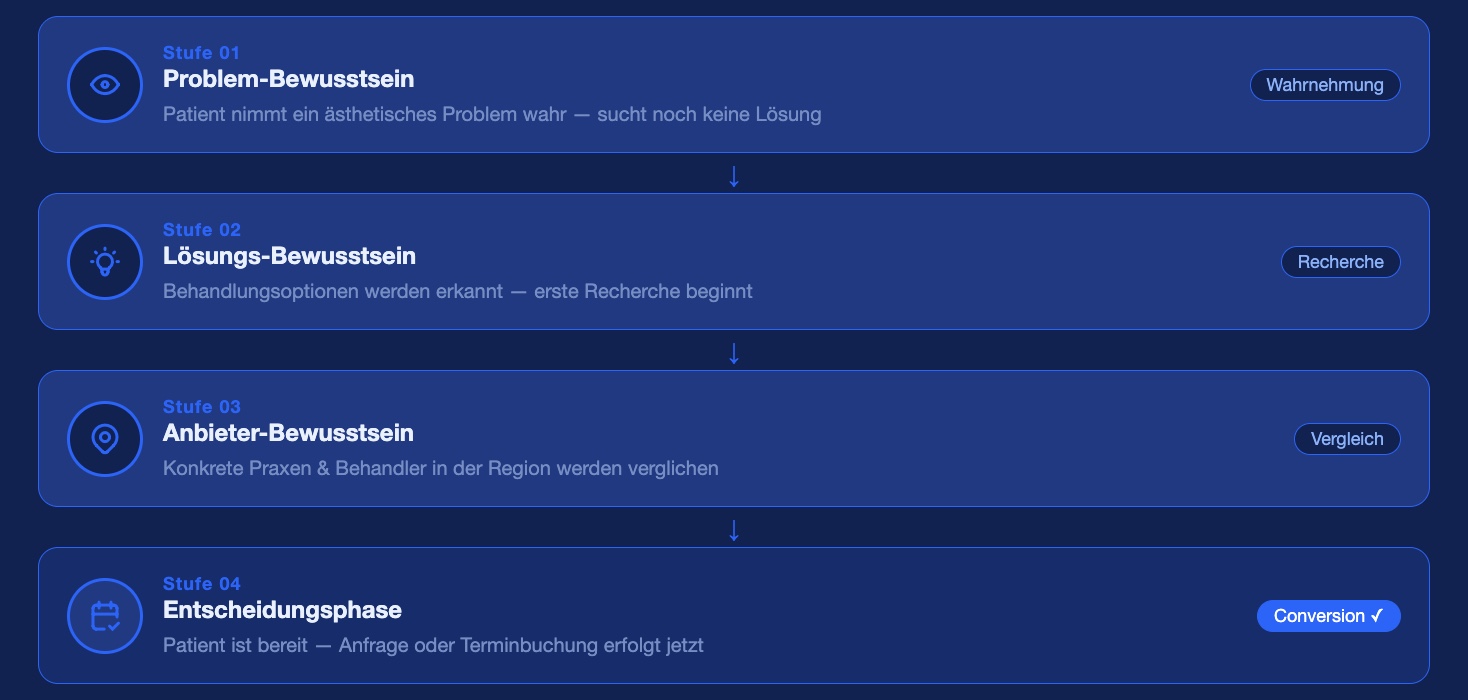
Practices that are only 4 visible at stage, fight in the most expensive and most competitive segment of the market. In contrast, those who use content, organic reach and targeted marketing across all four stages to engage, build a structural competitive advantage and win patients before the competition even comes into view.
4. Turning off campaigns too early instead of optimizing them
One of the most common operational mistakes: A campaign runs for three to five days, the initial results are disappointing and the ads are turned off. What is overlooked here: Modern advertising algorithms on Meta or Google require a learning phase to target campaigns to the right people.
Without sufficient data, the algorithm cannot not optimize. In concrete terms, this means:
- There are not enough website actions being trackedto effectively optimize campaigns.
- There is no custom audience being built from previous website visitors or leads.
- There is too little datato automatically find similar potential customers automatically to find.
- There is a lack of reliable data to meaningfully compare ads, target audiences, or offers with one another.
The learning phase of a campaign typically lasts between seven and fourteen days, depending on the budget and target audience .. Anyone who optimizes or shuts down prematurely is evaluating results based on incomplete data and making the wrong decisions.
Great campaign results aren't achieved through knee-jerk reactions, but through disciplined testing, measuring, and optimizing over sufficient periods of time.
5. Lack of trust architecture

Performance Marketing is only as effective, as the trust your practice has built online. If you run ads but fail to provide convincing trust signals , loses potential leads between the click and the inquiry without even realizing it.
A functional trust architecture includes:
- Reviews: Actively managed Google reviews with a high volume and regular new entries
- Social media presence: An active, professional Instagram account featuring consistent treatment results and insights into daily practice life
- Website trust elements: Physician profiles, qualifications, certifications, awards
- Review portals: Jameda, Google, and industry-specific platforms as a cross-channel portfolio of evidence
The direct correlation: If a practice runs ads without a visible foundation of trust, it pays higher costs per click for a significantly lower conversion rate. Trust effectively lowers the Patient Acquisition Cost (PAC) because potential patients are ready to inquire sooner when the practice's digital presence is already convincing.
What aesthetic practices should do instead
The good news: all five mistakes can be fixed. With a structured approach, you can see results within measurable improvements in just a few weeks.
This process has proven effective:
1. Secure the legal basis
Advertising materials, landing pages and forms should be checked for HWG- and GDPR-compliance before the campaign starts and regularly thereafter.
2. Build conversion infrastructure
Every treatment requires a clear landing page with easy-to-understand benefits and a simple contact method. Otherwise, valuable advertising budget is wasted.
3. Expand target audience strategy
Only targeting patients who have already made up their minds limits your growth. Campaigns for different levels of awareness lower PAC in the long term and strengthen regional brand awareness.
4. Plan time and budget
Algorithms need sufficient data. Campaigns should run for at least ten to fourteen days before they are evaluated or adjusted.
5. Continuously build trust
Reviews, social media, and documented treatment results build trust. Regular and long-term maintenance.
Conclusion
Non- compliant advertising, a poorly converting website, a lack of understanding your target audience, giving up too early Switching off of campaigns and insufficient trust-architecture. These five mistakes are widespread in aesthetic medicine and can all be systematically corrected.
Practices that consistently implement these fundamentals, reduce their PAC, increase their conversion rate, and acquire patients structurally – regardless of competitive market pressure.
Curia Consulting supports aesthetic practices and clinics in the DACH-region with exactly these questions: from legally compliant campaign strategy to optimizing the conversion-infrastructure, all the way to building a solid digital foundation of trust.
Your practice could already be performing better with the right system
We help aesthetic practices fix their marketing mistakes, increase their conversion rates, and sustainably lower their PAC.
FAQ
Frequently asked questions about marketing for aesthetic practices
Hier finden Sie Antworten auf die wichtigsten Fragen
What is the Therapeutic Products Advertising Act (HWG) and why is it relevant to aesthetic marketing?
The German Therapeutic Products Advertising Act (Heilmittelwerbegesetz) regulates how medicinal products, medical devices, and medical services may be advertised. Of particular relevance to aesthetic practices are the prohibition of misleading claims of success, strict requirements for before-and-after photos, and restrictions on advertising certain treatments. Violations can lead to formal cease-and-desist notices from competitors or consumer protection associations, often without prior warning.
What is the minimum recommended duration for an advertising campaign for an aesthetic practice?
As a rule of thumb, a campaign should run for at least ten to fourteen days before being evaluated or significantly altered. Meta and Google algorithms need this time to collect sufficient data and optimize delivery to the most relevant users. With a lower budget, this learning phase may take longer.
How much does a cease-and-desist notice for an HWG violation cost?
Costs vary significantly depending on the case. Simple cease-and-desist notices with an undertaking often start at 1,000 to 2,000 euros, but can quickly reach five figures in cases of repeated violations or more complex situations, including opposing counsel fees, your own legal costs, and potential contractual penalties.
What are Patient Acquisition Costs (PAC) and how can they be reduced?
PAC refers to the average total cost incurred to acquire a new patient—from the initial ad to the completed treatment. It can be reduced through better website conversion rates, faster response times to inquiries, increased trust through reviews and social proof, and more efficient campaign management.
Why do some practices perform significantly better than others with the same budget?
The difference is almost never the budget itself, but rather the combination of legally compliant communication, optimized conversion infrastructure, targeted messaging across all stages of awareness, and a solid foundation of digital trust. Practices that systematically leverage all five factors achieve structurally better results, regardless of market competition.